Skip to content
Skip
3k

Blog

Native Swift on Android, Part 3: Sharing a Swift Model Layer

Native Swift on Android, Part 3: Sharing a Swift Model Layer

This is the third installment in our series exploring native Swift on Android. In Part 1 we discuss bringing the Swift compiler and toolchain to Android. Part 2 introduces Skip’s tooling and technology for Swift Android app development and leads you through the creation of your first cross-platform Swift app.

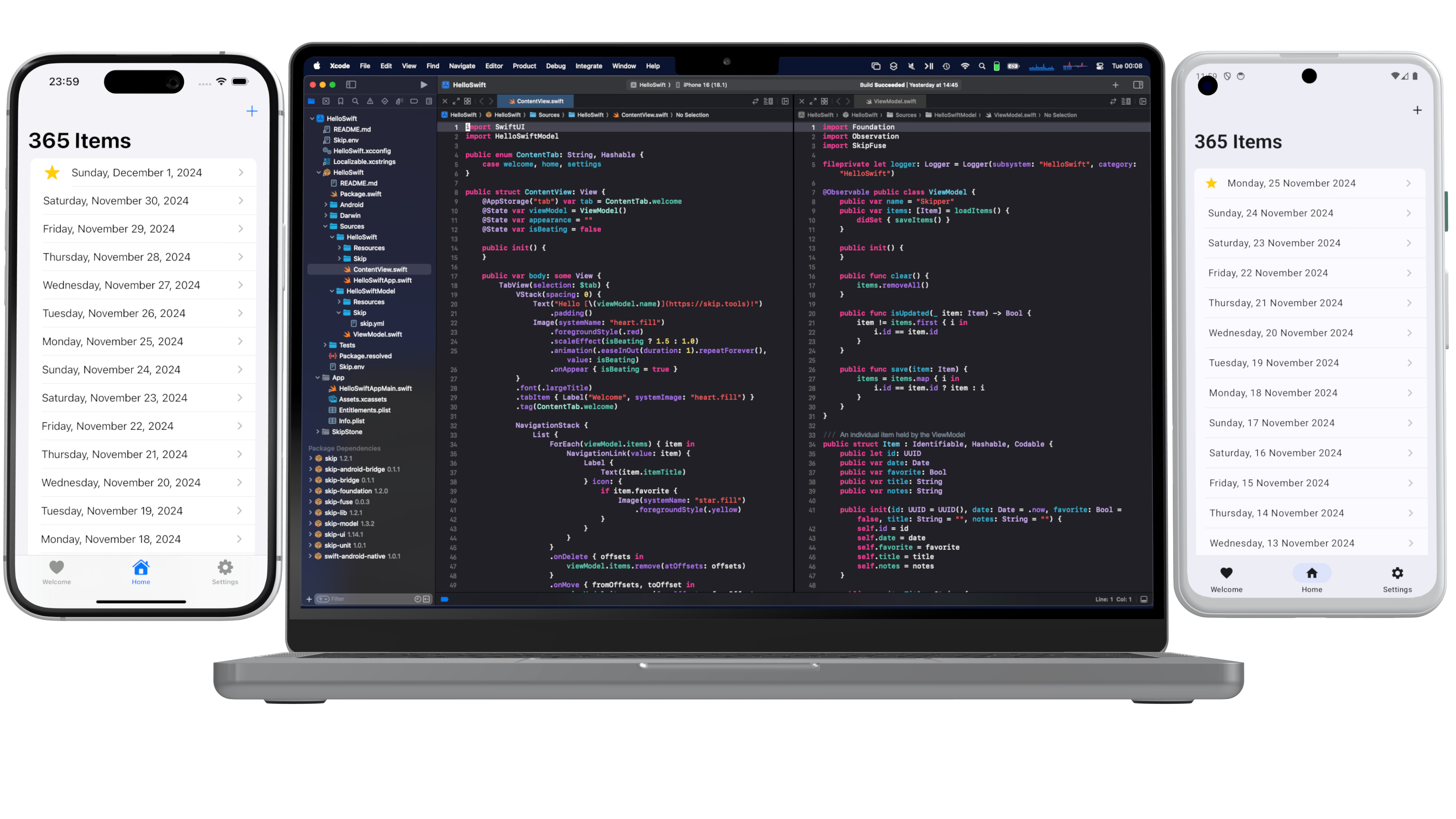
The app we create in Part 2 uses a compiled Swift model layer and a shared SwiftUI interface, which Skip transpiles to Jetpack Compose on Android. The following diagram illustrates this dual-platform, single-codebase architecture:

Skip Native Diagram

In this article, by contrast, we create separate iOS and Android apps. The iOS app and shared model layer are written in Swift and SwiftUI using Xcode. The Android app is written in Kotlin and Jetpack Compose using Android Studio, and it imports the compiled Swift model as a dependency. This structure allows you to reuse the lower layers of your app logic while fully embracing the standard IDEs and UI toolkits on each platform:

Skip Shared Model Diagram

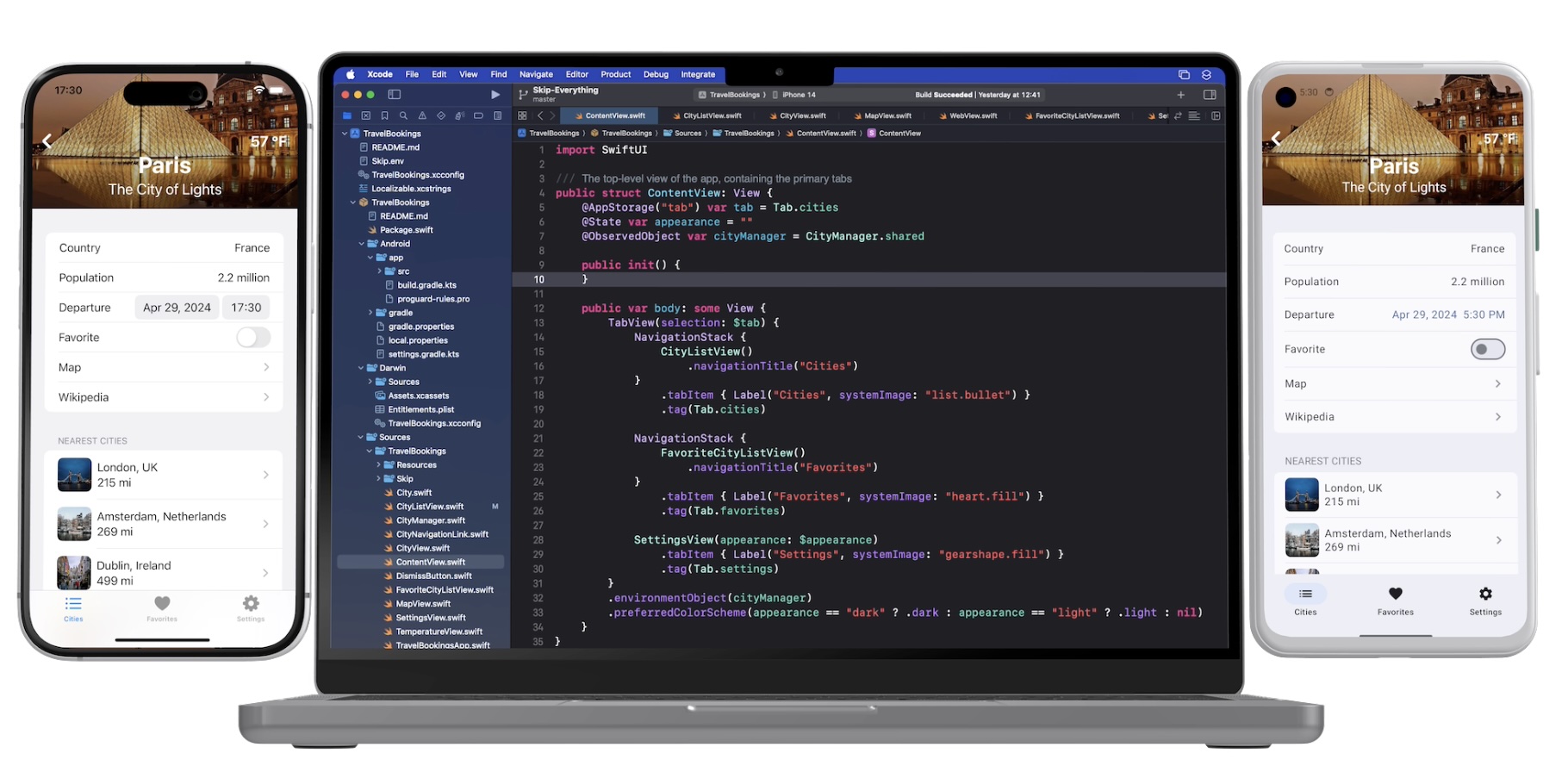
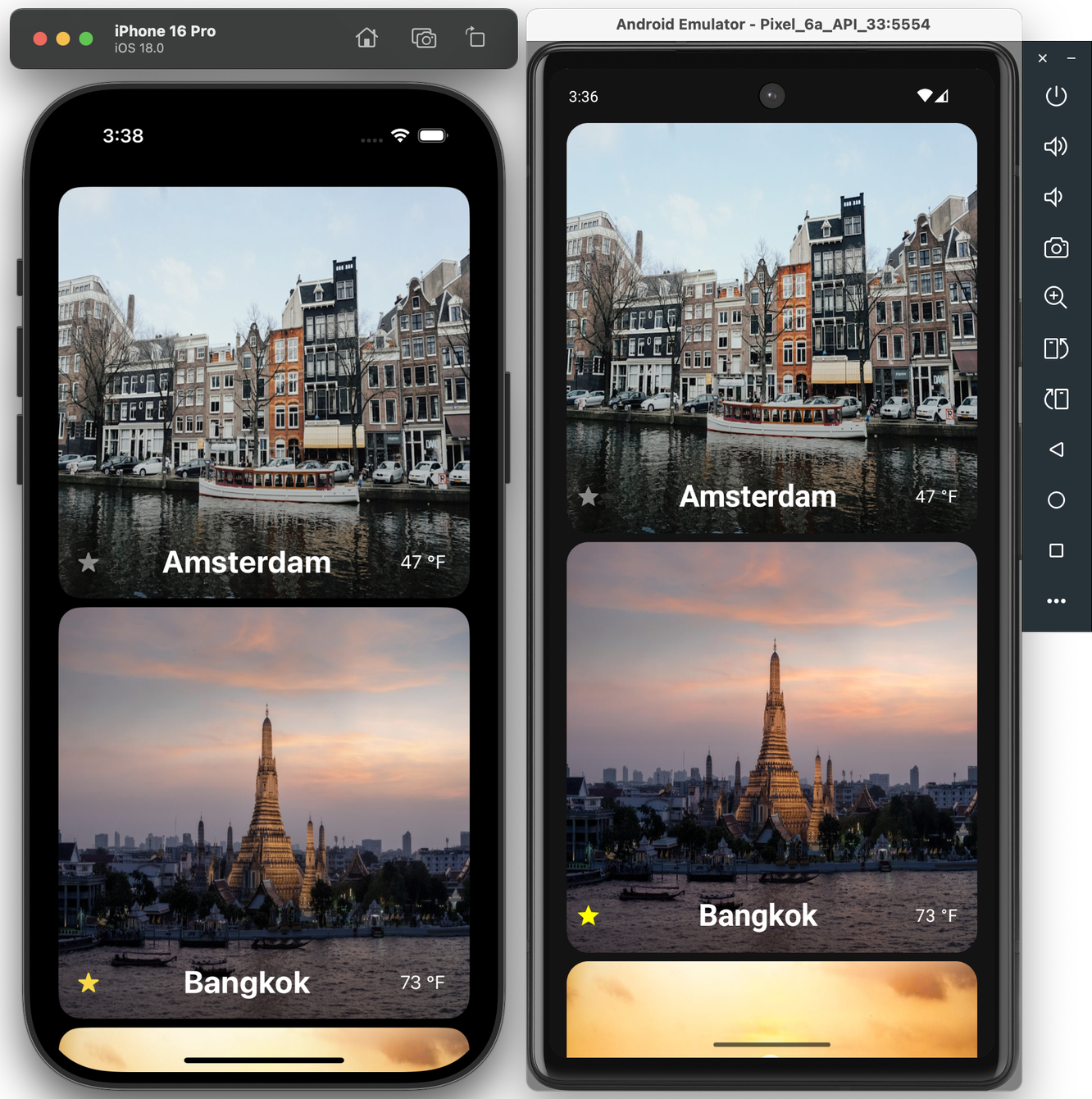
Simulators displaying the same app on iPhone and Android

Our sample apps in this installment are iOS and Android versions of TravelPosters, a simple scrolling grid displaying posters of famous cities. Each poster displays the city’s name and current temperature. You can mark your favorites, and these favorites are remembered across app launches.

Our shared TravelPostersModel, therefore, has the following responsibilities:

  • Provide a list of cities. Each city must supply its name and a poster image URL.
  • Fetch the current temperature for each city.
  • Allow the addition and removal of cities from an observable set of favorites.
  • Persist and restore the set of favorites across uses of the app.

And given that our model will power both iOS and Android apps, we should add the following table-stakes Android requirements:

  • We must be able to access our Swift model API naturally in Kotlin, just as in Swift.
  • Our mutable set of favorites must be observable not only to SwiftUI state tracking, but to Jetpack Compose state tracking as well.

Fortunately, Swift is more than up to the task of meeting our model’s general requirements, and Skip’s SkipFuse technology will handle transparently bridging it all to Kotlin and Compose!

If you plan on following along and you haven’t already installed Skip, follow Part 2’s installation instructions. This will quickly get you up and running with Skip, its requirements, and the native Swift Android toolchain.

As a good, modern citizen of the Swift ecosystem, Skip works atop Swift Package Manager. Our shared model will be a Swift package configured to use skipstone, the Skip build plugin. You could create this package and configure its use of Skip by hand, but Skip provides tooling to help.

First, create the folder structure we’ll use to hold our shared model as well as our iOS and Android apps. You do not have to house your apps together, but this is the structure we’ll use in this article.

mkdir travelposters
cd travelposters
mkdir iOS
mkdir Android

Now use the skip tool to create the shared model package:

skip init --native-model travel-posters-model TravelPostersModel
Output of running skip init --native-model

This command generates a travel-posters-model SwiftPM package containing the TravelPostersModel Swift module. The --native-model option ensures that the module will already be configured to compile natively on Android, and to bridge its public API to Kotlin. Our particular needs, however, require a couple of additional steps.

  1. We know that parts of our model will be @Observable. In order for @Observables to work on Android, we need a dependency on skip-model. Edit the generated Package.swift to add it:

    ...
    let package = Package(
    name: "travel-posters-model",
    ...
    dependencies: [
    .package(url: "https://source.skip.tools/skip.git", from: "1.2.0"),
    .package(url: "https://source.skip.tools/skip-model.git", from: "1.0.0"), // <-- Insert
    .package(url: "https://source.skip.tools/skip-fuse.git", "0.0.0"..<"2.0.0")
    ],
    targets: [
    .target(name: "TravelPostersModel",
    dependencies: [
    .product(name: "SkipFuse", package: "skip-fuse"),
    .product(name: "SkipModel", package: "skip-model") // <-- Insert
    ],
    plugins: [.plugin(name: "skipstone", package: "skip")]),
    ...
    ]
    )
  2. The --native-model option we passed to skip init will configure Skip to automatically bridge our model’s public API from compiled Swift to Android’s ART Java runtime. This is done through the skip.yml configuration file included in every Skip module. By default, however, Skip assumes that you’ll be bridging to transpiled Swift and SwiftUI code. Instead, we’ll be consuming the model from pure Kotlin, so we want to optimize the bridging for Kotlin compatibility. We do this by editing the Sources/TravelPostersModel/Skip/skip.yml file to look like this:

    skip:
    mode: 'native'
    bridging:
    enabled: true
    options: 'kotlincompat'

You can read more about the magic of bridging in the documentation.

With these updates in place, we’re now ready to iterate on our shared Swift model code!

The beauty of cross-platform Swift code is how boring it is. You can browse our model’s complete content on GitHub, but it looks more or less exactly as you’d expect given the previously-enumerated requirements. It has some Codable structs to represent cities and weather:

public struct City : Identifiable, Codable {
public typealias ID = Int
public let id: ID
public let name: String
public let imageURL: URL
...
}
public struct WeatherConditions : Hashable, Codable {
public let temperature: Double // 16.2
public let windspeed: Double // 16.6
...
}

The model uses URLSession and JSONDecoder to fetch the current weather:

public struct Weather : Hashable, Codable {
public let latitude: Double // e.g.: 42.36515
public let longitude: Double // e.g.: -71.0618
public let time: Double // e.g.: 0.6880760192871094
...
public let conditions: WeatherConditions
enum CodingKeys: String, CodingKey {
case latitude = "latitude"
case longitude = "longitude"
case time = "generationtime_ms"
...
case conditions = "current_weather"
}
public static func fetch(latitude: Double, longitude: Double) async throws -> Weather {
let factor = pow(10.0, 4.0) // API expects a lat/lon rounded to 4 places
let lat = Double(round(latitude * factor)) / factor
let lon = Double(round(longitude * factor)) / factor
let url = URL(string: "https://api.open-meteo.com/v1/forecast?latitude=\(lat)&longitude=\(lon)&current_weather=true")!
var request = URLRequest(url: url)
request.setValue("skipapp-sample", forHTTPHeaderField: "User-Agent")
let (data, response) = try await URLSession.shared.data(for: request)
return try JSONDecoder().decode(Weather.self, from: data)
}
}

And it includes an @Observable CityManager to provide the list of cities and to persist favorites:

@Observable public final class CityManager {
private static let favoritesURL = URL.applicationSupportDirectory.appendingPathComponent("favorites.json")
public static let shared = CityManager()
private init() {
do {
self.allCities = try JSONDecoder().decode([City].self, from: localCitiesJSON.data(using: .utf8)!).sorted { c1, c2 in
c1.name < c2.name
}
} catch {
logger.log("error loading cities: \(error)")
}
do {
self.favoriteIDs = try JSONDecoder().decode([City.ID].self, from: Data(contentsOf: Self.favoritesURL))
logger.log("loaded favorites: \(self.favoriteIDs)")
} catch {
logger.log("error loading favorites: \(error)")
}
}
public var allCities: [City] = []
public var favoriteIDs: [City.ID] = [] {
didSet {
logger.log("saving favorites: \(self.favoriteIDs)")
do {
try FileManager.default.createDirectory(at: Self.favoritesURL.deletingLastPathComponent(), withIntermediateDirectories: true)
try JSONEncoder().encode(favoriteIDs).write(to: Self.favoritesURL)
} catch {
logger.log("error saving favorites: \(error)")
}
}
}
}
private let localCitiesJSON = """
...
"""

While this code is generally pretty standard, it does contain a few concessions to the realities of current Swift support on Android:

  • In files that create an OSLog.Logger or that define an @Observable type, we also import SkipFuse. In fact, Skip will surface a build warning in Xcode if you attempt to define an @Observable in a bridged file that doesn’t import the SkipFuse framework!

    SkipFuse is an umbrella framework that “fuses” the Swift and Android worlds. It makes sure that your OSLog messages are routed to Android’s Logcat logging service, that your @Observable state is tracked by Jetpack Compose, and more - all without changes to your normal code path.

  • You may notice other unfamiliar import patterns as well. For example, Foundation on Linux and Android is divided into Foundation, FoundationNetworking, FoundationInternationalization, and FoundationXML. So in Weather.swift where we use URLSession, we have the following imports:

    import Foundation
    #if canImport(FoundationNetworking)
    import FoundationNetworking
    #endif
  • Though we do not need them here, you may encounter #if os(Android) checks to conditionalize code for Android or Darwin platforms in other Android-supporting codebases, just as you’ll often find #if os(macOS) conditions in macOS-supporting codebases.

  • We’re loading our cities JSON from a static string, but more tyically you would load the contents from a resource. SkipFuse supports bundling Swift module resources as idiomatic Android assets.

  • While many Swift packages like Apple’s swift-algorithms compile cleanly for Android out of the box, others will require minor changes, and still others - particularly those that tie into the hardware or use one of Apple’s many OS “Kits” - may never work on Android. Swift on Android is still in its infancy, and it will take time for developers to build and test their packages on this new-to-Swift platform.

You can read much more about both the advantages and the limitations of native Swift on Android in our full native Swift documentation. For the most part, though, relax and enjoy coding with the full power and expressiveness of Swift!

Due to limitations on build plugins, building the travel-posters-model package in Xcode does not perform an Android build. It only builds for iOS. Rather, there are two simple ways to build for Android: use skip export to create an Android library archive, which we explore later in this article, or run the unit tests.

Skip configures every native module with an extra unit test that builds the module for Android, transpiles your XCTests to JUnit tests, and runs them. Thus you’ll see two sets of results on every test run: first from XCTest and then from JUnit on Android. Frequently running your tests is a great way to catch both logic bugs and Android compilation errors early. Read more in the native testing documentation.

Because our model is a standard SwiftPM package, you incorporate and use it on iOS like any other package. We briefly outline the steps we took to create and configure our sample iOS app below. Feel free to skip this section!

  1. Use Xcode to create a new Workspace in the travelposters directory alongside the travel-posters-model package.

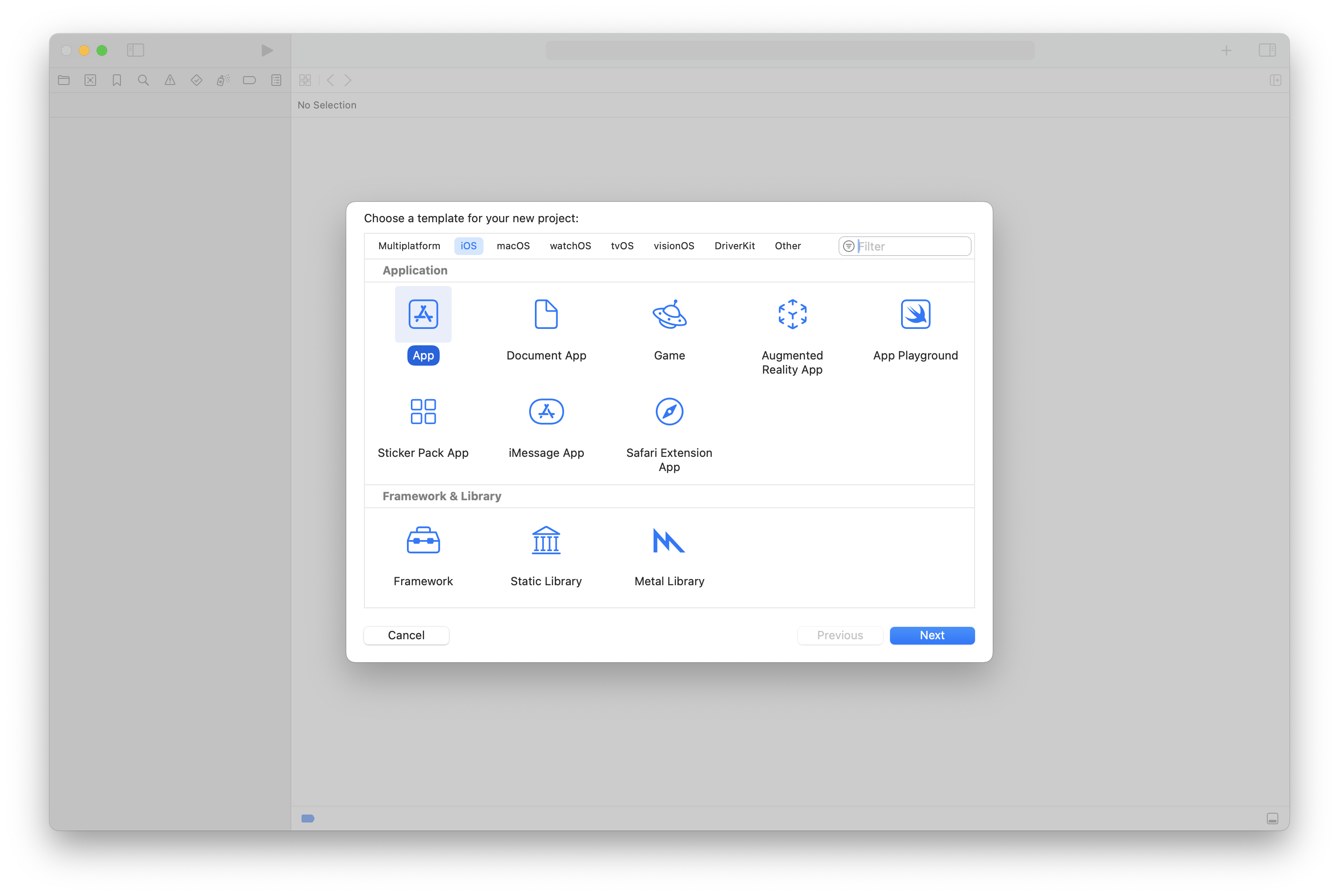
  2. Use Xcode to create a new App project in the travelposters/iOS directory. Close the project after creating it, because we’re going to add it to our Workspace instead.

    Creating a new app project in Xcode
  3. Add the travel-posters-model package to your Workspace.

  4. Add the iOS/TravelPosters/TravelPosters.xcodeproj app to your Workspace.

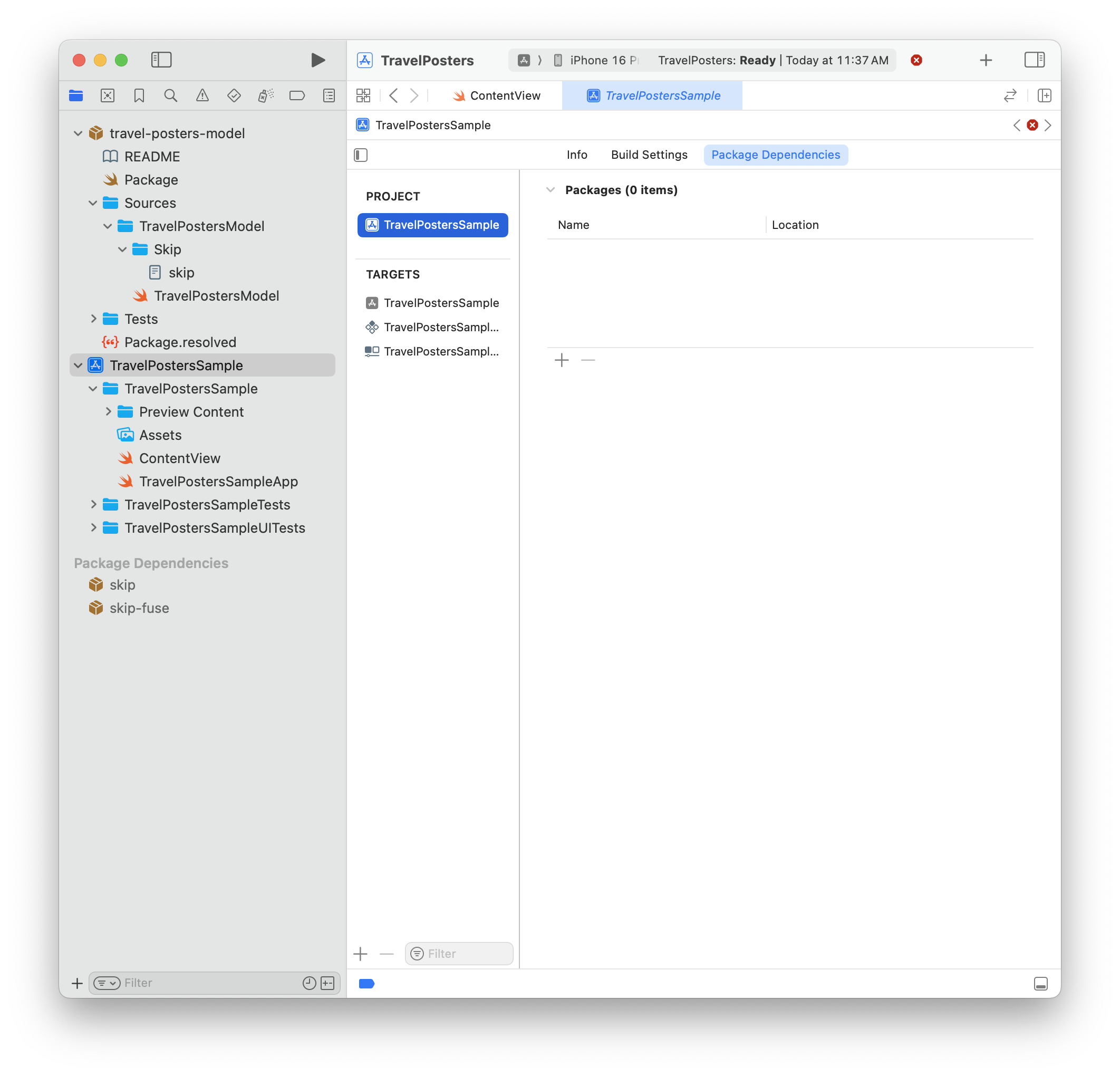
  5. Add a package dependency from the app to the travel-posters-model local package.

    Adding a package dependency in Xcode

You can now use your Xcode Workspace to iterate on both the shared model package and your iOS app. Browse the complete iOS TravelPosters app here.

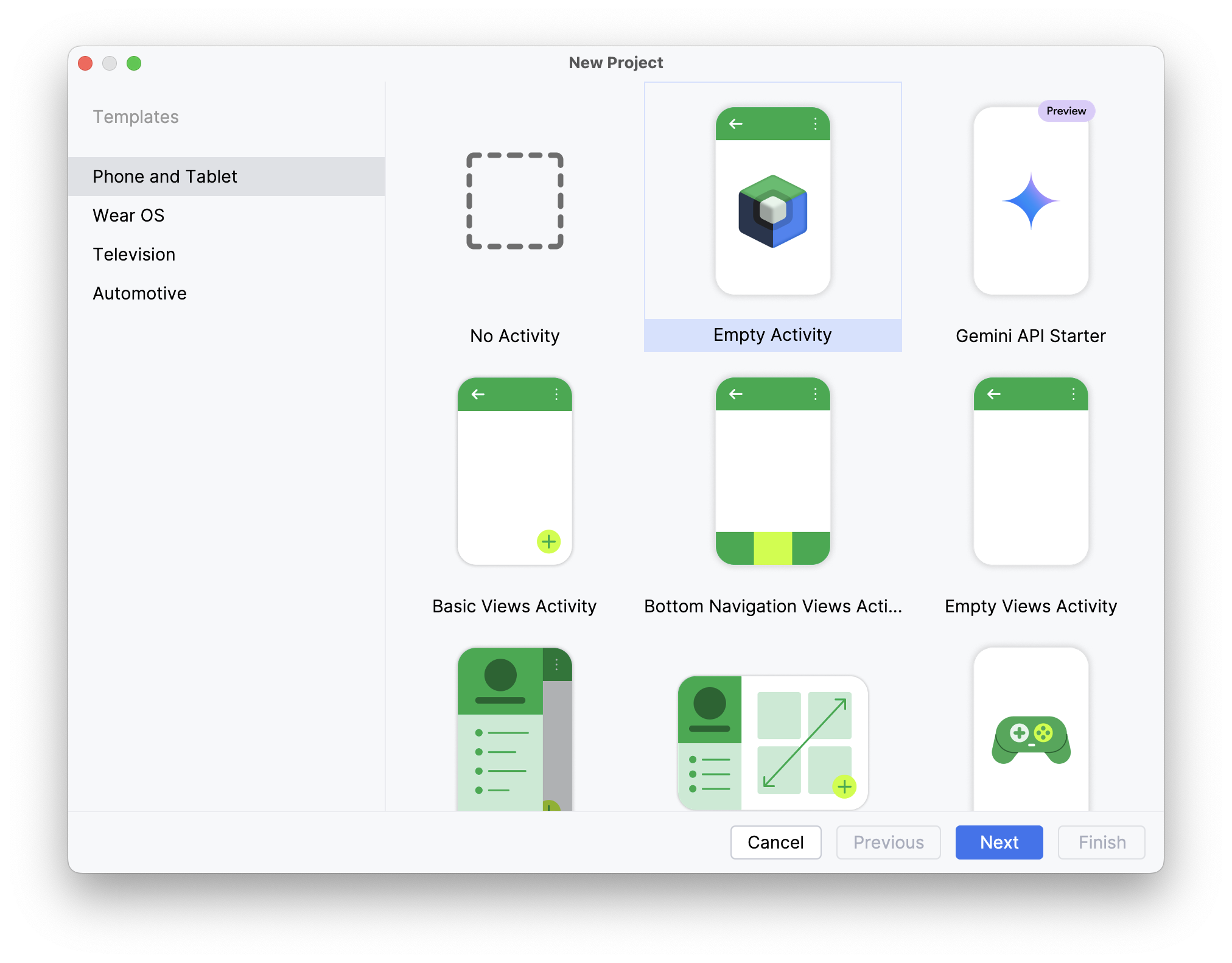
We create our TravelPosters Android app using Android Studio, starting with the “Empty Activity” template. Tell Android Studio to place the app in our travelposters/Android folder.

Creating a new app project in Android Studio

Next, make Android/lib, Android/lib/debug, and Android/lib/release directories. This is where we’ll place our compiled Swift model and Skip libraries.

Creating directories for our compiled Swift model

We must also configure our project to use the new lib directories. Edit the app module’s build.gradle.kts file to add these and other necessary dependencies:

...
dependencies {
...
implementation("org.jetbrains.kotlin:kotlin-reflect:2.1.0") // For reflection used by Skip
implementation("io.coil-kt:coil-compose:2.7.0") // For AsyncImage used to display posters
debugImplementation(fileTree(mapOf(
"dir" to "../lib/debug",
"include" to listOf("*.aar", "*.jar"),
"exclude" to listOf<String>()
)))
releaseImplementation(fileTree(mapOf(
"dir" to "../lib/release",
"include" to listOf("*.aar", "*.jar"),
"exclude" to listOf<String>()
)))
}

To prevent errors in the deployed app, include the following in build.gradle.kts as well:

android {
packaging {
jniLibs {
// doNotStrip is needed to prevent errors like: java.lang.UnsatisfiedLinkError: dlopen failed: empty/missing DT_HASH/DT_GNU_HASH in "/data/app/…/base.apk!/lib/arm64-v8a/libdispatch.so" (new hash type from the future?) (see: https://github.com/finagolfin/swift-android-sdk/issues/67)
keepDebugSymbols.add("**/*.so")
}
}
}

Finally, our app needs internet access permissions to fetch weather and display remote images. Update its AndroidManifest.xml file:

<?xml version="1.0" encoding="utf-8"?>
<manifest xmlns:android="http://schemas.android.com/apk/res/android"
xmlns:tools="http://schemas.android.com/tools">
<uses-permission android:name="android.permission.INTERNET" />
...
</manifest>

Find the complete TravelPosters Android app here. The next sections detail how to export our shared model to the Android app and how to use it from our Kotlin code.

We’ve configured our Android app to look in the Android/lib/debug and Android/lib/release folders for our model, but how do we populate these folders?

The skip export command generates Android archives of a target Swift package and all of its dependencies. It has many options, which you can explore with skip export help. The following Terminal command builds our travel-posters-model and its dependencies for Android in debug mode and places the resulting .aar library archives in the Android/lib/debug directory:

skip export --project travel-posters-model -d Android/lib/debug/ --debug

To generate release archives instead:

skip export --project travel-posters-model -d Android/lib/release/ --release
Syncing Android Studio

There are many ways to automate this process, from simple scripting to git submodules to publishing the Android travel-posters-model output to a local Maven repository. Use whatever system fits your team’s workflow best.

For example, to re-build and re-launch the app after making changes to the Swift code, you might run:

Terminal window
skip export --project travel-posters-model -d Android/lib/debug/ --debug
gradle -p Android installDebug
adb shell am start -a android.intent.action.MAIN -c android.intent.category.LAUNCHER -n tools.skip.travelposters/tools.skip.travelposters.MainActivity

Now that we’ve set up the Android app to depend on our shared Swift model, what is it like to actually use the model in Kotlin and Compose code? The answer is that - thanks to SkipFuse bridging - it’s surprisingly natural!

Before we dive into using our model, though, we have to make a single call in our Android app’s main Activity to initialize integration. Skip has extended Foundation.ProcessInfo for this purpose:

MainActivity.kt
...
class MainActivity : ComponentActivity() {
override fun onCreate(savedInstanceState: Bundle?) {
super.onCreate(savedInstanceState)
skip.foundation.ProcessInfo.launch(context = this) // <-- INSERT
enableEdgeToEdge(statusBarStyle = SystemBarStyle.dark(Color.TRANSPARENT))
setContent {
...
}
}
...
}

No additional changes to Android’s normal startup code path are needed.

This article is not a tutorial on using Jetpack Compose. Rather, we will focus on the places where our Android UI interacts with Swift, starting with the CityList function for displaying the scrolling list of posters:

...
import travel.posters.model.CityManager // <-- 1
@Composable
fun CityList(...) {
val cityManager = CityManager.shared // <-- 2
LazyVerticalGrid(...) {
for (city in cityManager.allCities) { // <-- 3
item {
CityPoster(city, isFavorite = { cityManager.favoriteIDs.contains(city.id) }, setFavorite = { isFavorite ->
// 4
val favoriteIDs = cityManager.favoriteIDs.toMutableList()
if (isFavorite && !favoriteIDs.contains(city.id)) {
favoriteIDs.add(city.id)
cityManager.favoriteIDs = favoriteIDs
} else if (!isFavorite) {
favoriteIDs.remove(city.id)
cityManager.favoriteIDs = favoriteIDs
}
})
}
}
}
}

We’ve annotated the code above with four numbered comments. Let’s explain each:

  1. Our TravelPostersModel module is exposed to Kotlin in the travel.posters.model package. Skip simply divides your CamelCase Swift module names into ”.”-separated Kotlin package names. Single-word packages are reserved in Kotlin, so if your module name consists of a single word, Skip appends “.module”. For example, module Util turns into Kotlin package util.module.
  2. Your Swift types and API have equivalent names and signatures in Kotlin.
  3. The Swift CityManager.allCities property of type [City] bridges to a Kotlin kotlin.collections.List<City>. Consult the bridging reference to learn more about specific type mappings.
  4. Here we’re performing standard Compose state hoisting to manage the favorites list. Notice that we simply update our model - we do not explicitly trigger a change to the UI. Like SwiftUI, Compose automatically reacts to change in observed state, and SkipFuse ensures that our @Observable CityManager is fully and transparently integrated in Compose state tracking.

Each item in the city list is a CityPoster. Let’s examine that function as well:

...
import travel.posters.model.City
import travel.posters.model.Weather
@Composable
fun CityPoster(city: City, isFavorite: () -> Boolean, setFavorite: (Boolean) -> Unit) {
Box {
val url = city.imageURL // <-- 1
AsyncImage(...)
...
Column(...) {
Row(...) {
...
Icon(imageVector = Icons.Filled.Star,
modifier = Modifier.clickable {
setFavorite(!isFavoriteState.value)
}
)
...
Text(text = city.name, ...)
...
Box {
...
LaunchedEffect(city.id, degrees) {
try { // <-- 2
val c = Weather.fetch( // <-- 3
latitude = city.latitude,
longitude = city.longitude
).conditions.temperature
...
} catch (exception: Exception) {
Log.e("TravelPosters", "Error fetching weather: $exception")
}
}
...
}
}
}
}
}

Once again, we’ve added numbered comments to points of interest in the code above:

  1. In addition to bridging your own types as well as built-in types like numbers, strings, arrays, and dictionaries, SkipFuse translates common Foundation types like Data, Date, URL, and UUID to their Kotlin equivalents. In this case the City.imageURL property of type Foundation.URL maps to a java.net.URI. Again, see the bridging reference for details.
  2. Our Weather.fetch Swift function is marked throws. If the native call produces an error, the bridged Kotlin call with throw a standard Kotlin exception.
  3. Weather.fetch is an async Swift function. Skip therefore generates a Kotlin suspend function and integrates the call with Kotlin coroutines. Hence the use of a LaunchedEffect in our Compose code.

As you can see, you invoke your Swift APIs naturally in Kotlin - almost exactly as if they were written in Kotlin themselves! Swift custom types, built-in types, and common Foundation types all translate to Kotlin/Java equivalents, thrown errors cause Kotlin exceptions, async Swift functions use Kotlin coroutines, etc. The goal is that using a module written in Swift should be almost indistinguishable from using a package written in Kotlin.

If you haven’t already, check out Part 1 and especially Part 2 of this series.

If you’d like to learn much more about SkipFuse, bridging, and native Swift on Android, consider reading our Native Swift Tech Preview documentation.

You may also be interested in the nascent swift-java project, which is designed to facilitate communication between server-side Swift and Java libraries. While that is a very different environment than Android apps interacting with modern Kotlin APIs, they do overlap, and you might find swift-java's bridging approach useful. We anticipate that as it matures, this bridge and Skip’s native bridging will begin to align more closely in their techniques and implementation details.

Additional posts in the native Swift on Android series:

Many cross-platform solutions allow you to share code, but they typically come with serious downsides:

  • Performance issues from the use of interpreters and/or complex runtimes (Javascript)
  • High memory watermarks and unpredictable hitches caused by garbage collection (Javascript, Kotlin)
  • Lack of transparent integration with SwiftUI and/or Compose state tracking (C/C++)
  • Portability and memory safety concerns (C/C++)

Swift exhibits none of these problems. Its safety, efficiency, and expressiveness make it an ideal choice for cross-platform development. Swift is already a first-class citizen on Apple platforms, and Skip’s native tooling and technology ensures seamless integration with Android and Compose as well.

Whether you’re creating a single dual-platform app like we did in Part 1, separate iOS and Android apps with a shared model layer and bespoke interfaces like we did in this article, or anything in between, sharing code with Swift can save you significant time and effort when writing your app. More important than the up front savings, though, is the savings over time. A shared Swift codebase will eliminate endless hours of repeated bug fixes, enhancements, team coordination, and general maintenance over the life of your software.

December Skip Newsletter

Skip December Newsletter

Welcome to the December edition of the Skip.tools newsletter! This month we will showcase some of the improvements and advancements we've made to the Skip platform, along with some current events and a peek at our upcoming roadmap.

Skip and Compiled Swift on Android

The big news this month is the release of the Skip's native compiled Swift technology preview! Now you are not limited to just using transpiled packages in Skip apps: you can also embed fully native Swift using our Android toolchain and transparent bridge generation. The SkipFuse framework enables you to move seamlessly between native Swift and your transpiled Jetpack Compose user interface. This unlocks the entire universe of pure-Swift packages for use in your Android app! Read the introductory blog post at /blog/skip-native-tech-preview/ and then browse the full documentation at /docs/native/.

Screenshot of native toochain development

New SkipUI Features

SkipUI is the framework that turns your SwiftUI into Jetpack Compose for Android. It enables you to write a single user-interface for both platforms using their platform-native toolkits. SkipUI supports converting nearly all SwiftUI constructs into Compose, but there are sometimes minor deficiencies and quirks that need to be implemented separately for Android. Over the past weeks, we've improved SkipUI with:

  • Support for custom SVG images in asset catalogs
  • Enabling .alert() sheets to containTextField and SecureField views
  • Support for .rotation3DEffect for all views
  • Implementing .interactiveDismissDisabled to conditionally prevent interactive dismissal of sheets

You can always get the latest Skip features and fixes from right within Xcode, by simply clicking File > Packages > Update to Latest Versions. And if you are building from the command-line, swift package update  will do the same thing.

Tip: Customizing with Android-only SwiftUI modifiers

SkipUI supports Android-specific SwiftUI modifiers to customize Material colors, components, and effects. Check out the "Material" section of our SkipUI documentation to see how: /docs/modules/skip-ui/#material

Skip on Talking Kotlin

We were thrilled to join hosts Sebastian and Márton on the JetBrains Talking Kotlin podcast! The episode was just released, and you can listen to it at https://talkingkotlin.com/going-from-swift-to-kotlin-with-skip/ or watch it at https://www.youtube.com/watch?v=mig81rSWVqM. “Going from Swift to Kotlin with Skip: In a slightly unconventional episode, Sebastian and Márton talk to the founders of Skip, an iOS-to-Android, Swift-to-Kotlin transpiler solution. Marc and Abe have a background working on both Apple platforms and the JVM, and their latest project is a bridge across these two ecosystems.”

Android Police Interview

Another instance of Skip in the press was an interview with the popular Android Police publication, titled: “How the development wall between Android and iOS may soon come down”. You can read the whole thing at: https://www.androidpolice.com/skip-interview

That's all for now

You can follow us on Mastodon at https://mas.to/@skiptools, and join in the Skip discussions at http://forums.skip.dev/. The Skip FAQ at /docs/faq/ is there to answer any questions, and be sure to check out the video tours at /tour/. And, as always, you can reach out directly to us on our Slack channel at /slack/.

Happy Skipping!

Native Swift on Android, Part 2: Your First Swift Android App

Native Swift on Android, Part 2: Your First Swift Android App

Swift is Apple’s recommended language for app development, and with good reason. Its safety, efficiency, and expressiveness have made it easier than ever to build fast, polished, and robust apps for the Apple ecosystem. Recent stories about Swift on Windows and Swift on the Playdate highlight developers’ desire to take advantage of Swift on other platforms too. In this series, we explore writing native Swift apps for Android with Skip.

Since its 1.0 release earlier this year, Skip has allowed developers to create cross-platform iOS and Android apps in Swift and SwiftUI by transpiling your Swift to Android’s native Kotlin language. Now, the Skip team is thrilled to give you the ability to use native, compiled Swift for cross-platform development as well.

Part 1 of this series described bringing a native Swift toolchain to Android. Being able to compile Swift on Android, however, is only the first small step towards real-world applications. In this and other installments, we introduce the other pieces necessary to go from printing “Hello World” on the console to shipping real apps on the Play Store:

  • Integration of Swift functionality like logging and networking with the Android operating system.
  • Bridging technology for using Android’s Kotlin/Java API from Swift, and for using Swift API from Kotlin/Java.
  • The ability to power Jetpack Compose and shared SwiftUI user interfaces with native Swift @Observables.
  • Xcode integration and tooling to build and deploy across both iOS and Android.

The best way to learn is often by example. This post introduces you to native Swift apps on Android by exploring the “Hello Swift” app. This is the starter app that Skip generates when you initialize a new project, and it provides a fully-configured launch point for your own cross-platform Swift app development.

Before we can explore the sample, though, we have to install the tools necessary to create it - including Swift for Android!

First, ensure that you are on a macOS 14+ machine with Xcode 16, Android Studio, and Homebrew installed.

Next, open Terminal and type the following commands to install Skip and the native Android toolchain.

brew tap skiptools/skip
brew install skiptools/skip/skip
skip android sdk install

Finally, verify that everything is working with an additional Terminal command:

skip checkup --native

If everything passes successfully, you can now create your first cross-platform native Swift app with the command:

skip init --native-model --open-xcode --appid=com.xyz.HelloSwift hello-swift HelloSwift HelloSwiftModel

That’s a long one! This tells Skip to initialize a new native Swift starter app and open it in Xcode. The app will use the hello-swift project folder, and it will be divided into two modules: a HelloSwift UI layer and a HelloSwiftModel model layer.

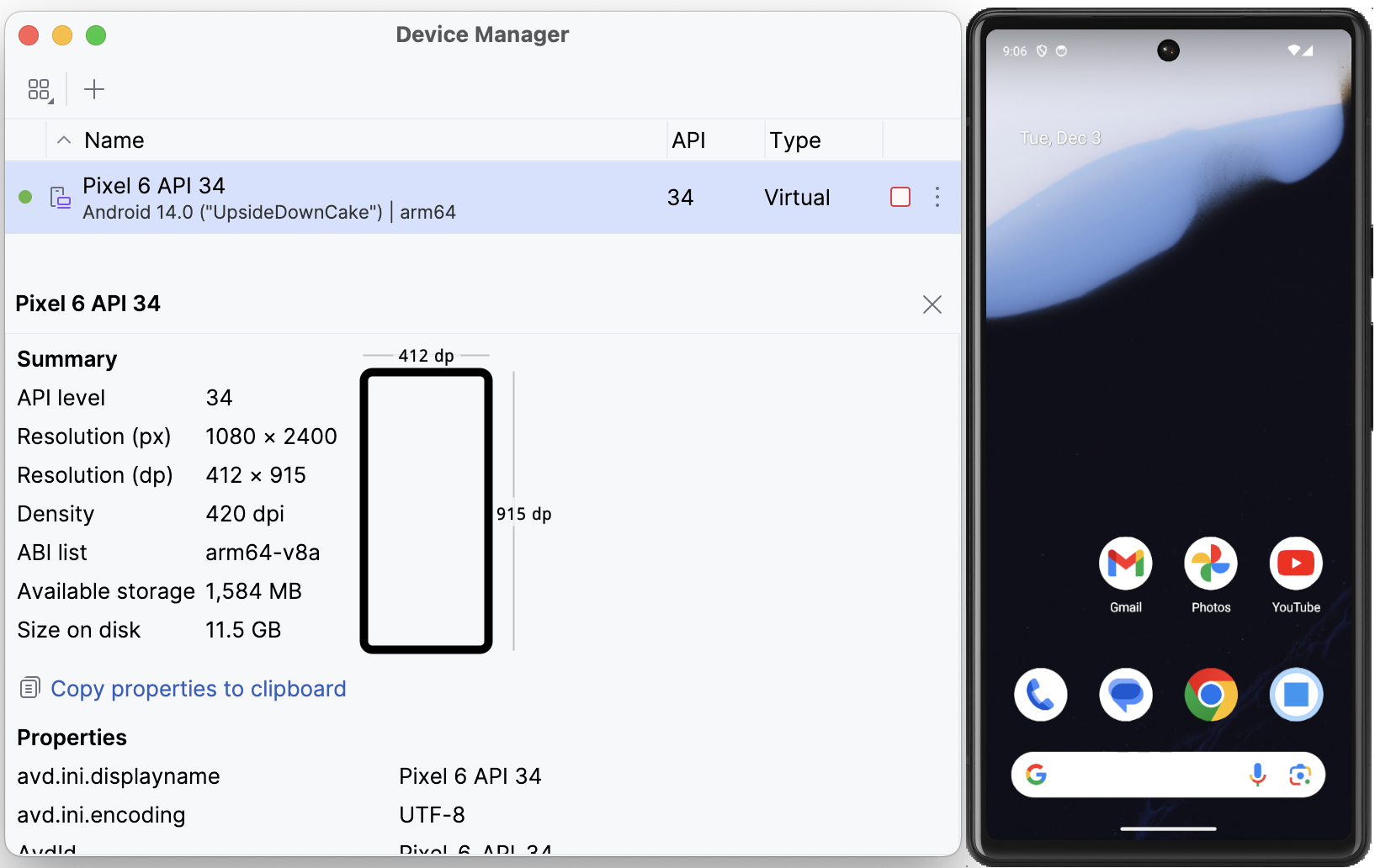
When you enter this command, Skip will generate the project, perform some checks, and then the app will open in Xcode. Before running it, though, you must first launch the Android emulator by opening Android Studio.app and selecting the Virtual Device Manager from the ellipsis menu of the Welcome dialog. From there, use the plus toolbar button to Create Device (e.g., “Pixel 6”) and then Launch the emulator.

Screenshot of the Android Studio Device Manager

Finally, select your desired iOS simulator in Xcode, then build and run the “HelloSwift” target.

The first build will take some time to compile the Skip libraries, and you may be prompted with a dialog to affirm that you trust the Skip plugin. Once the build and run action completes, the app will open in the selected iOS simulator, and at the same time the generated Android app will launch in the currently-running Android emulator.

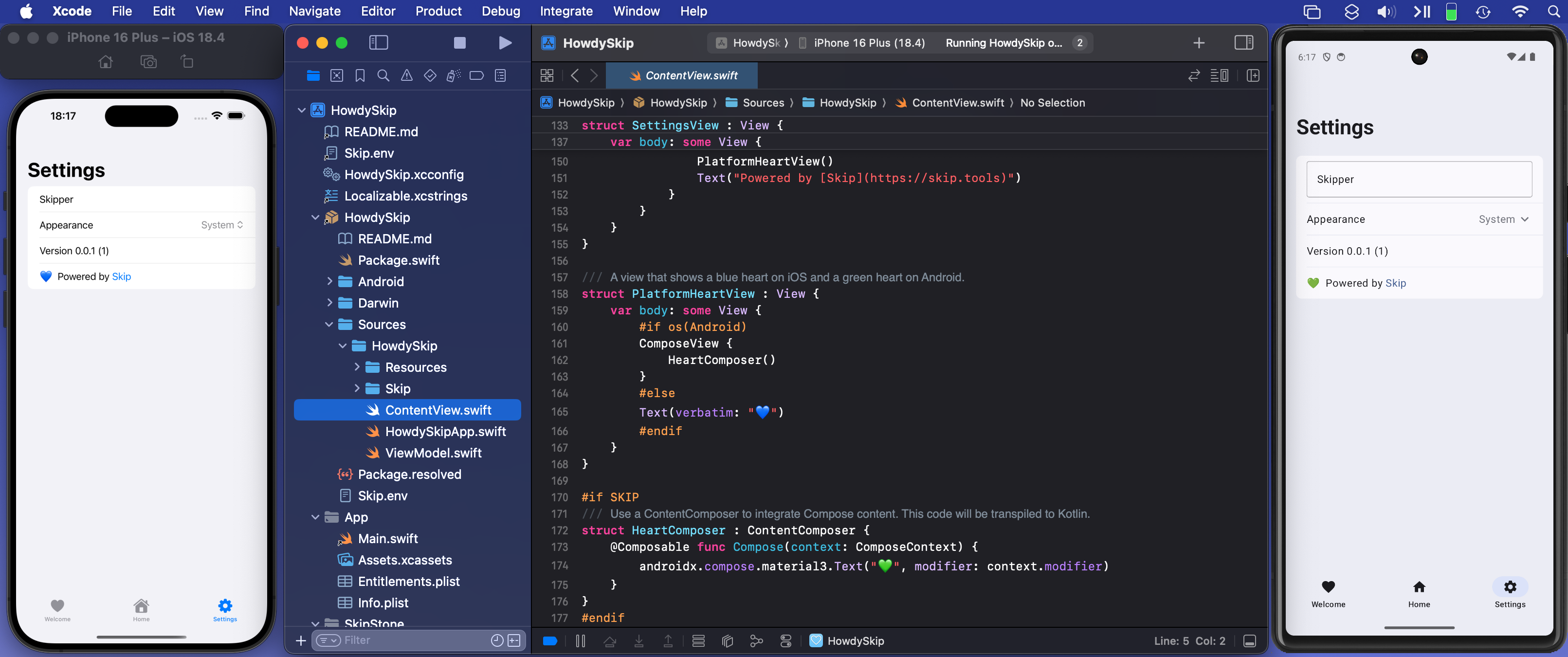
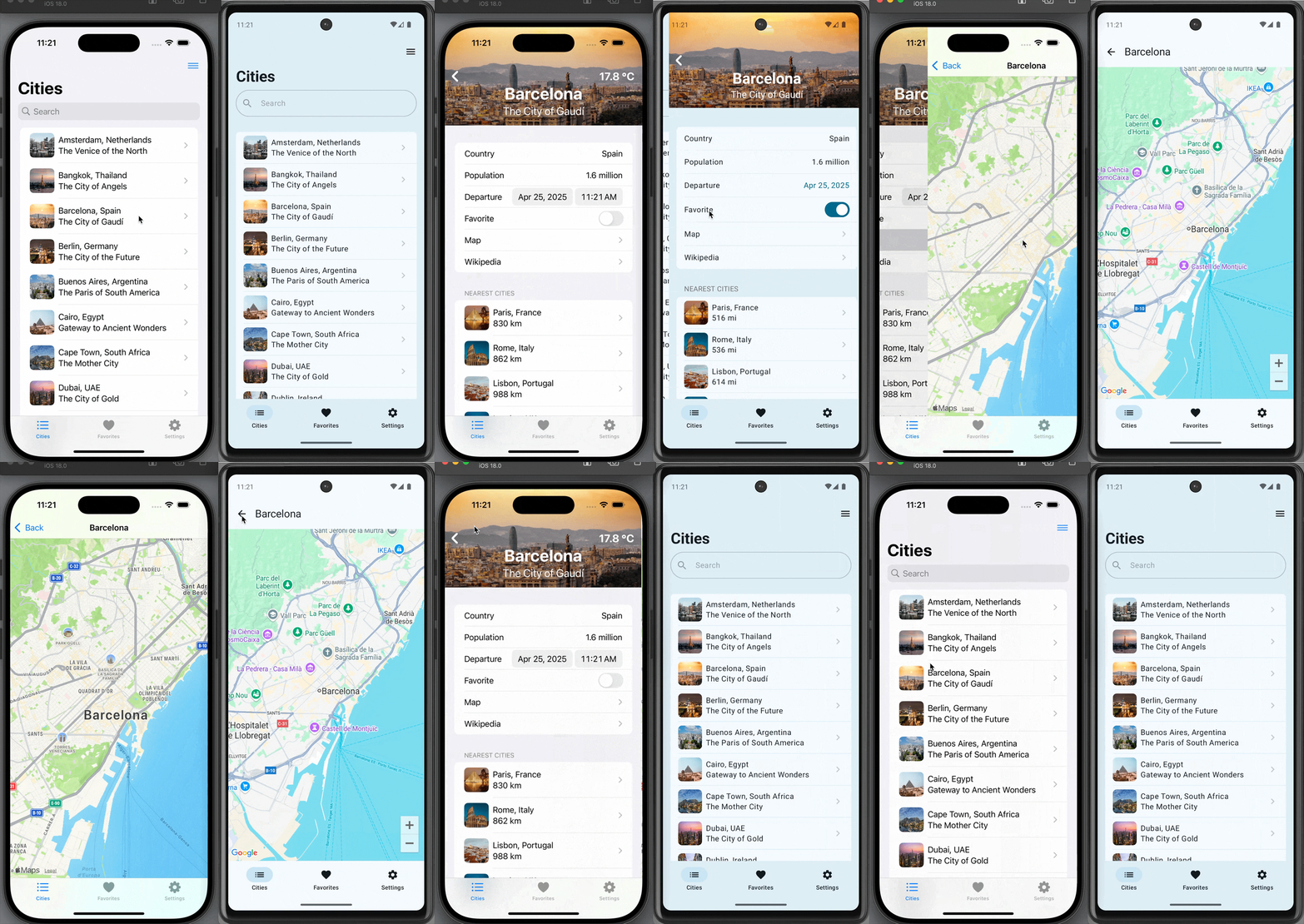
Screenshot of the Hello Swift native app

“Hello Swift” is a very simple CRUD app that contains a list of dated items. You can browse the full source code in Xcode, or online in its GitHub repository. At a high level, the Xcode project embeds a Swift Package Manager package called “HelloSwift”, which contains two targets:

  1. The HelloSwift module contains the SwiftUI for the app’s user interface. It will run natively on iOS and be transpiled by Skip’s “SkipStone” build plugin into Kotlin and Jetpack Compose for Android.
  2. HelloSwiftModel is a pure Swift module that contains an @Observable ViewModel class. It will be compiled natively for both iOS and Android using the Swift toolchain for each platform.

The app allows you to add new items with the plus button, and items can be deleted and re-arranged by swiping and dragging. Tapping an item navigates to a form with editable fields for the various properties: title, date, a favorites toggle, and notes. HelloSwiftModel defines an item as:

public struct Item : Identifiable, Hashable, Codable {
public let id: UUID
public var date: Date
public var favorite: Bool
public var title: String
public var notes: String
}

These items are held by an @Observable ViewModel class:

@Observable public class ViewModel {
public var items: [Item] = loadItems() {
didSet { saveItems() }
}
}

And in the HelloSwift SwiftUI layer, the notes are managed by a SwiftUI List within a NavigationStack:

public struct ContentView: View {
@State var viewModel = ViewModel()
public var body: some View {
NavigationStack {
List {
ForEach(viewModel.items) { item in
NavigationLink(value: item) {
Label {
Text(item.itemTitle)
} icon: {
if item.favorite {
Image(systemName: "star.fill")
.foregroundStyle(.yellow)
}
}
}
}
.onDelete { offsets in
viewModel.items.remove(atOffsets: offsets)
}
.onMove { fromOffsets, toOffset in
viewModel.items.move(fromOffsets: fromOffsets, toOffset: toOffset)
}
}
.navigationTitle(Text("\(viewModel.items.count) Items"))
.navigationDestination(for: Item.self) { item in
ItemView(item: item, viewModel: $viewModel)
.navigationTitle(item.itemTitle)
}
.toolbar {
ToolbarItemGroup {
Button {
withAnimation {
viewModel.items.insert(Item(), at: 0)
}
} label: {
Label("Add", systemImage: "plus")
}
}
}
}
}
}

On iOS, both the HelloSwift and HelloSwiftModel targets are native Swift, so communication between the two layers is seamlessly handled by the Swift dependency. On Android, however, recall that the HelloSwift module’s SwiftUI is transpiled to Kotlin. That Kotlin needs to be able to interact with the HelloSwiftModel module’s compiled Swift, which involves bridging the two languages and runtimes.

Skip’s bridging solution is called “SkipFuse”. Using the SkipStone build plugin, SkipFuse automatically generates bridging code that enables transparent communication between the two layers. This is modeled in the following diagram, which illustrates how the two modules are combined into final iOS and Android app packages:

Skip Native Diagram

The details of Skip’s bridging are discussed in the documentation. To summarize, the bridging system parses the public types, properties, and functions of your Swift module and exposes them to the transpiled Kotlin layer of your user interface. It supports the Observation framework, so you can use @Observable classes to manage application state in a way that is tracked by your UI, ensuring that your data and user interface are always in sync.

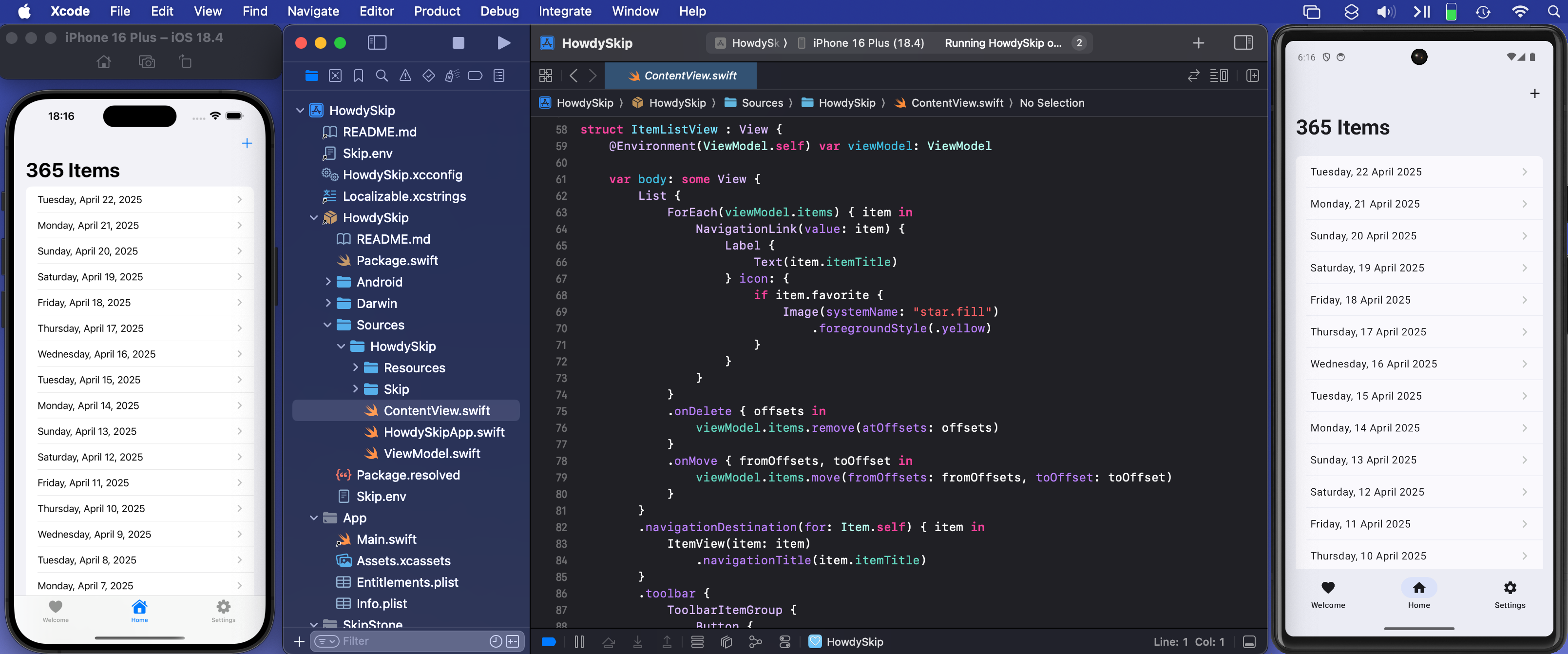
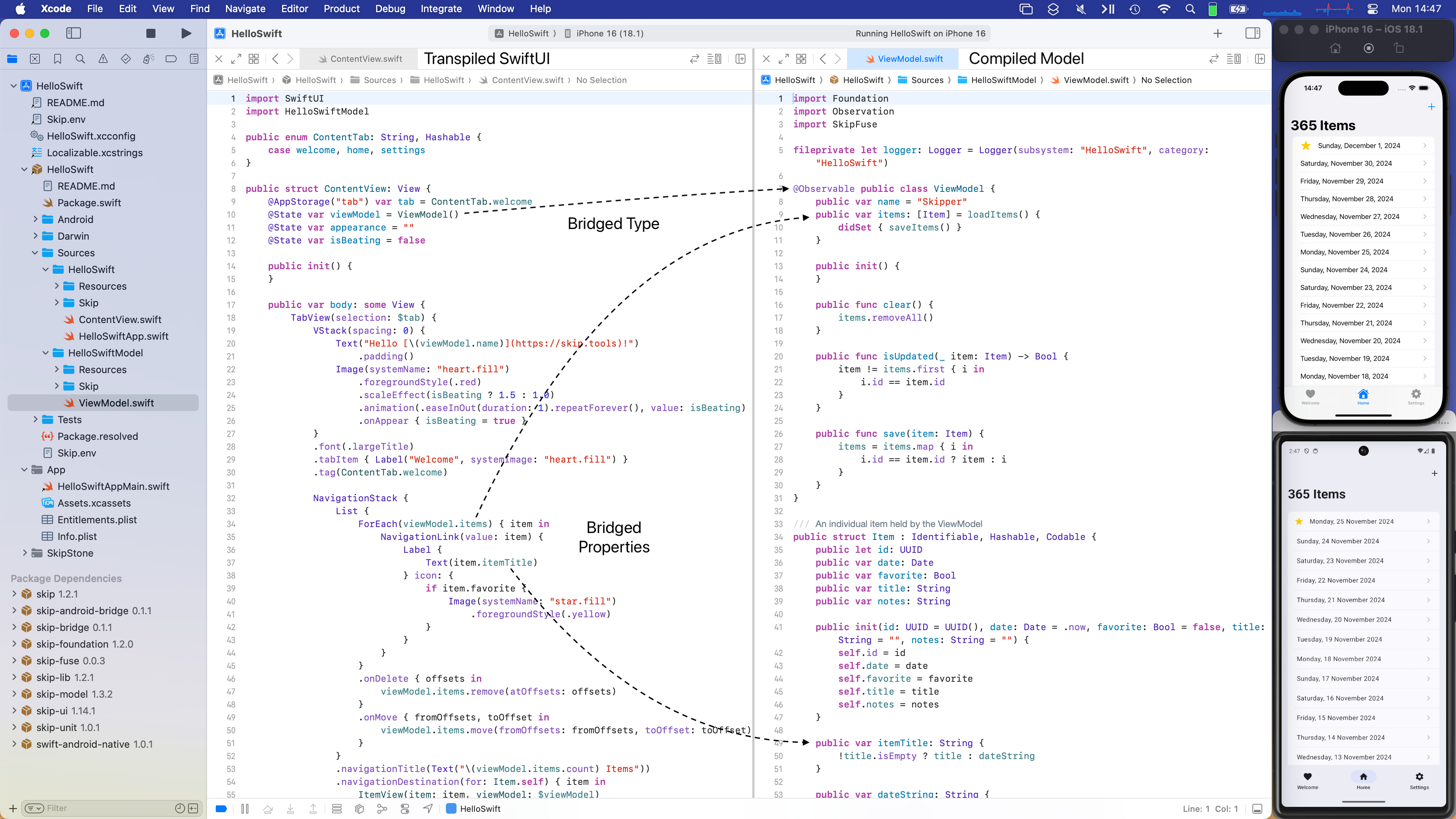
The following screenshot shows a split view between the HelloSwift module’s ContentView.swift and the HelloSwiftModel module’s ViewModel.swift. It demonstrates how the user interface layer communicates with the model layer in exactly the same way on both iOS and Android, although the latter is crossing a language boundary:

Screenshot of the Hello Swift native app

Skip integrates with the Xcode and Swift Package Manager build systems using the SkipStone Xcode plugin. This plugin transpiles your non-native modules from Swift to Kotlin, and it generates the needed bridging code for communication between your native Swift modules and Kotlin or Java.

The skip init command you used to create the “Hello Swift” app also adds a build script to the generated Xcode project. This build script launches Android’s Gradle build tool to compile and package the plugin’s output into an Android APK. When your project has native modules, this includes compiling the native code using the Android toolchain described in Part 1.

But how does Skip know which modules to transpile and which are native? Every Skip module must include a Skip/skip.yml configuration file in its source folder. Here is the configuration for a native Swift module whose public API is bridged to Kotlin:

skip:
mode: 'native'
bridging: true

Once you have specified that a module is bridging, the entire process is automatic. You can iterate on both your native and transpiled code and re-launch the app, and the bridging code will be updated without needing to run an external tool or perform any other manual process.

Now that you’ve created your first native Swift Android app, what’s next? Well, remember that this is just a starter app designed to get you up and running. It is meant to be torn apart and modified, so feel free to experiment by changing the model and UI in Xcode!

If you’d like to learn much more about SkipFuse, bridging, and native Swift on Android, consider reading our Native Swift Tech Preview documentation. Many of the topics it covers are the subjects of additional posts in this series. For example, while we saw “Hello Swift” bridge its native Swift model layer to its transpiled Kotlin user interface, we haven’t discussed bridging Kotlin API for use by native Swift at all. The documentation covers this in depth.

You may also be interested in the nascent swift-java project, which is designed to facilitate communication between server-side Swift and Java libraries. While that is a very different environment than Android apps interacting with modern Kotlin APIs, they do overlap, and you might find swift-java's bridging approach useful. We anticipate that as it matures, this bridge and Skip’s native bridging will begin to align more closely in their techniques and implementation details.

Additional posts in the native Swift on Android series:

Swift’s safety, efficiency, and expressiveness make it an excellent development language, and its use across platforms is spreading. This series focuses on sharing native Swift code between iOS and Android with Skip. Part 1 introduced the native Swift toolchain for Android. Now in Part 2, you’ve created your first cross-platform Swift app. There is a lot of interesting territory that we haven’t yet explored, so check out Part 3 and beyond!

September 2024 Mastodon Posts

Instructions
Desktop: Hover or click to play videos and GIFs
Mobile: Tap missing videos and GIFs to preview. Tap post to view and play media

Native Swift on Android, Part 1: Setup, Compiling, Running, and Testing

You may already be familiar with Skip as a tool for bringing your Swift iOS apps to Android. Skip takes a novel transpilation approach, where we integrate with the Xcode build system to convert your Swift code into Kotlin. This allows us to create an Android library for every build of your Swift package, or to launch an Android version of your SwiftUI app on every Xcode Run.

We’ve discussed the advantages of a transpilation-based strategy in the past. But despite the fact that Android is a Java/Kotlin-oriented platform, there are also significant benefits to compiled code. Skip has featured support for integrating with C code on both Android and iOS for a long time. It only makes sense that our transpiled Swift code should also integrate with compiled Swift code.

Swift Android Logo {: style=“text-align: center; width: 200px; margin: auto;”}

And so we are excited to announce the first technology preview of a native Swift toolchain and driver for Android! This toolset enables developers to build and run Swift executables and test cases on a connected Android device or emulator.

On a macOS development machine with Xcode and Homebrew installed, you can install the Swift 6.0 Android toolchain by opening a terminal and running:

brew install skiptools/skip/swift-android-toolchain@6.0

This will download the Swift Android SDK, along with all the dependencies it needs to build, run, and test Swift packages on Android.

If you’re an existing Skip user, make sure to also update your skip copy to version 1.1.1+:

skip upgrade

Unless you have an Android device handy, you will need to install the Android emulator in order to run executables and test cases in a simulated Android environment. The simplest way to do this is to download and install Android Studio, then launch it and open the “Virtual Device Manager” from the “More Actions” (or ellipsis menu) of the “Welcome to Android Studio” dialog. On the resulting “Device Manager” screen, select “Create virtual device”.

Android Emulator Setup 1: Welcome Screen Android Emulator Setup 2: Device Manager

On the “Select Hardware” screen, select a device (e.g., “Pixel 6”) and then on the “Select a system image” screen select one of the recommended images (e.g., “UpsideDownCake”, a.k.a. API 34), and then on the next screen name the device and select “Finish”. When you return to the “Device Manager” screen, you will see a new device (like “Pixel 6 API 34”), which you can then launch with the triangular play button. A little window titled “Android Emulator” will appear and the operating system will boot.

Android Emulator Setup 3: Select Hardware Android Emulator Setup 4: Select System Image Android Emulator Setup 5: Verify Connfiguration
Android Emulator Setup 6: Device Manager Android Emulator Setup 6: Running Emulator

Running Swift “Hello World” on Android

Section titled “Running Swift “Hello World” on Android”

Now that you have everything set up and have launched an Android emulator (or connected a physical Android device with developer mode enabled), it’s time to run some Swift!

Open a terminal and create a new Swift command-line executable called “HelloSwift”:

% mkdir HelloSwift
% cd HelloSwift
% swift package init --type=executable
Creating executable package: HelloSwift
Creating Package.swift
Creating Sources/main.swift

Just to make sure it works on macOS, run the program with the standard swift run command:

% swift run HelloSwift
Building for debugging...
Build of product 'HelloSwift' complete! (1.80s)
Hello, world!

And now, we will build and run it on the Android emulator (or device) using the Swift Android driver, which we include as part of the skip tool that was installed along with the toolchain:

% skip android run HelloSwift
Building for debugging...
Build complete! (10.90s)
[✓] Check Swift Package (0.68s)
[✓] Connecting to Android (0.05s)
[✓] Copying executable files (0.25s)
Hello, world!

Viola! There’s Swift running on Android. And just to prove to that we are really running on a different host, edit the Sources/main.swift file with your favorite editor (or run xed Sources/main.swift to edit it in Xcode), and add a platform check:

#if os(Android)
print("Hello, Android!")
#elseif os(macOS)
print("Hello, macOS!")
#else
print("Hello, someone other platform…")
#endif

Then run it on both macOS and Android:

% swift run HelloSwift
Building for debugging...
Build of product 'HelloSwift' complete! (0.47s)
Hello, macOS!
% skip android run HelloSwift
Building for debugging...
Build complete! (0.89s)
[✓] Check Swift Package (0.23s)
[✓] Connecting to Android (0.04s)
[✓] Copying executable files (0.23s)
Hello, Android!

Command-line tools are fun, but to really exercise Swift on Android, we want to be able to run test suites. This is how developers interested in creating cross-platform frameworks will be able to check for – and resolve – issues with their Swift code arising from platform differences.

Fortunately the skip android driver includes not just the run command, but also the test command, which will connect to the Android emulator/device and run through an XCTest test suite in the same way as swift test does for macOS.

To demonstrate, we can run the test suite for Apple’s swift-algorithms package, to make sure it runs correctly on Android:

% git clone https://github.com/apple/swift-algorithms.git
Cloning into 'swift-algorithms'...
Resolving deltas: 100% (1054/1054), done.
% cd swift-algorithms
% skip android test
Fetching https://github.com/apple/swift-numerics.git from cache
Fetched https://github.com/apple/swift-numerics.git from cache (0.87s)
Computing version for https://github.com/apple/swift-numerics.git
Computed https://github.com/apple/swift-numerics.git at 1.0.2 (0.57s)
Creating working copy for https://github.com/apple/swift-numerics.git
Working copy of https://github.com/apple/swift-numerics.git resolved at 1.0.2
Building for debugging...
[92/93] Linking swift-algorithmsPackageTests.xctest
Build complete! (25.91s)
[✓] Check Swift Package (0.74s)
[✓] Connecting to Android (0.06s)
[✓] Copying test files (0.27s)
Test Suite 'All tests' started at 2024-09-10 20:24:17.770
Test Suite 'swift-algorithms-C7A0585A-0DC2-4937-869A-8FD5E482398C.xctest' started at 2024-09-10 20:24:17.776
Test Suite 'AdjacentPairsTests' started at 2024-09-10 20:24:17.776
Test Case 'AdjacentPairsTests.testEmptySequence' started at 2024-09-10 20:24:17.776
Test Case 'AdjacentPairsTests.testEmptySequence' passed (0.001 seconds)
Test Case 'WindowsTests.testWindowsSecondAndLast' started at 2024-09-10 20:24:20.480
Test Case 'WindowsTests.testWindowsSecondAndLast' passed (0.0 seconds)
Test Suite 'WindowsTests' passed at 2024-09-10 20:24:20.480
Executed 8 tests, with 0 failures (0 unexpected) in 0.004 (0.004) seconds
Test Suite 'swift-algorithms-C7A0585A-0DC2-4937-869A-8FD5E482398C.xctest' passed at 2024-09-10 20:24:20.480
Executed 212 tests, with 0 failures (0 unexpected) in 2.702 (2.702) seconds
Test Suite 'All tests' passed at 2024-09-10 20:24:20.480
Executed 212 tests, with 0 failures (0 unexpected) in 2.702 (2.702) seconds

Everything passes. Hooray!

Not every package’s tests will pass so easily: Android is based on Linux – unlike the Darwin/BSD heritage of macOS and iOS – so there may be assumptions your code makes for Darwin that don’t hold true on Linux. Running through a comprehensive test suite is the best way to begin isolating, and then addressing, these platform differences.

Command line executables and unit tests are all well and good, but “Hello World” is not an app. To create an actual Android app, with access to device capabilities and a graphical user interface, you need to work with the Android SDK, which is written in Java and Kotlin. And you need to package and distribute the app in Android’s own idiomatic way, with self-contained libraries embedded in the application’s assembly.

This is where integration with Skip’s broader ecosystem comes into play. Additional installments of this series explore Skip’s system for transparently bridging compiled Swift to Java, Kotlin, and transpiled Swift - including Skip’s existing SwiftUI support for Android. This allows the best of all worlds: transpiled Swift to talk to Android libraries, SwiftUI on top of Jetpack Compose, and business logic and algorithms implemented in compiled Swift!

Screenshot

Additional posts in the native Swift on Android series:

The Swift toolchain for Android is the culmination of many years of community effort, in which we (the Skip team) have played only a very small part.

Even before Swift was made open-source, people have been tinkering with getting it running on Android, starting with Romain Goyet’s “Running Swift code on Android” attempts in 2015, which got some basic Swift compiling and running on an Android device. A more practical example came with Geordie J’s “How we put an app in the Android Play Store using Swift” in 2016, where Swift was used in an actual shipping Android app. Then in 2018, Readdle published “Swift for Android: Our Experience and Tools” on integrating Swift into their Spark app for Android. These articles provide valuable technical insight into the mechanics and complexities involved with cross-compiling Swift for a new platform.

In more recent years, the Swift community has had various collaborative and independent endeavors to develop a usable Swift-on-Android toolchain. Some of the most prominent contributors on GitHub are @finagolfin, @vgorloff, @andriydruk, @compnerd, and @hyp. Our work merely builds atop of their tireless efforts, and we expect to continue collaborating with them in the hopes that Android eventually becomes a fully-supported platform for the Swift language.

Looking towards the future, we are eager for the final release of Swift 6.0, which will enable us to publish a toolchain that supports all the great new concurrency features, as well as the Swift Foundation reimplementation of the Foundation C/Objective-C libraries, which will give us the the ability to provide better integration between Foundation idioms (bundles, resources, user defaults, notifications, logging, etc.) and the standard Android patterns. A toolchain is only the first step in making native Swift a viable tool for building high-quality Android apps, but it is an essential component that we are very excited to be adding to the Skip ecosystem.