Skip to content

mobile-development

8 posts with the tag “mobile-development”

Skip 2025 Retrospective and 2026 Roadmap

As 2025 comes to a close, we’ve been reflecting on how far Skip has advanced this year. What began nearly three years ago with a simple desire to enable cross-platform app development with Swift and SwiftUI has grown into a thriving ecosystem, a strong community of developers and contributors, and a platform powering real production apps across iOS and Android.

This year wasn’t just about growth in numbers. It was about expanding depth and breadth: deeper integrations, stronger foundations, and a clearer vision for the future of native Swift across the dominant mobile platforms.

Native Swift on Android Becomes Officially Supported

Section titled “Native Swift on Android Becomes Officially Supported”

The highlight of 2025 by far was the official release of the Swift SDK for Android on swift.org, along with Skip’s support in the form of Skip Fuse. Prior to the advent of Skip Fuse, Skip operated solely in transpiled mode (now called “Skip Lite”), which converts Swift source code to Kotlin. Skip Fuse, on the other hand, builds natively-compiled Swift targeting the Android platform, which both eliminates the limitations imposed by source transpilation, as well as unlocks the universe of thousands of native Swift packages that are compatible with the Android platform.

Interest in the Swift SDK for Android has exploded since the initial announcement and follow-up blog posts on swift.org. We at Skip are proud to be founding members of the Swift Android workgroup, and we are committed to the platform’s enduring stability and support. And where the scope of the workgroup ends, we complete the picture by providing the tooling, libraries, and support needed to build universal apps from a single Swift codebase.

Liquid Glass and the Wisdom of Staying Native

Section titled “Liquid Glass and the Wisdom of Staying Native”

The launch of iOS 26 and the emergence of Liquid Glass as the new interface style was a pivotal moment for the cross-platform app development technosphere, as well as a powerful validation of Skip’s core philosophy. From day one, Skip has avoided intermediating or re-implementing SwiftUI on iOS or other Apple platforms. By staying fully native, Skip was able to support Liquid Glass on Day 1, automatically benefiting every Skip-based app without rewrites or workarounds (see our blog post on the topic).

In contrast, other cross-platform toolkits — such as Flutter and Compose Multiplatform — have found themselves stranded, incapable of adopting Liquid Glass and stuck on the previous UI generation with their mimicked faux-native components. For iOS users, that means outdated interfaces and an exacerbation of an already uncanny-valley non-native experience. For developers, it means frustration, limitation, and an inability to achieve the highest-quality app experience that their businesses demand.

Skip’s belief is that by embracing native platforms wholly — not abstracting them away — is the best path forward, both for users and developers. SkipUI maps un-intermediated SwiftUI on iOS to native Jetpack Compose on Android, guaranteeing that the user experience is always performant and familiar to users of the respective platforms.

A stock Skip app has just a few core dependencies: SkipUI, which provides a bridge from the SwiftUI API to a native Compose UI on Android, along with SkipFoundation, SkipModel, and SkipLib. But Skip also facilitates a thriving ecosystem of optional libraries, providing features and integrations that unlock the vast capabilities of third-party libraries and services and provide a unified dual-platform API surface.

Throughout 2025, Skip’s library ecosystem has matured and expanded dramatically. The community and core team introduced a wide range of new dual-platform frameworks designed to solve real-world problems without compromise. Some of our most popular integrations, like SQLite, Bluetooth, Firebase, Supabase, and WebView, have improved greatly through the help of outside contributions. These APIs were refined, edge cases were resolved, documentation improved, and real production feedback shaped work on of these frameworks.

In addition, we have some newer entrants to the Skip ecosystem, including:

  • SkipNFC and SkipDevice for unlocking low-level hardware capabilities
  • SkipStripe for Stripe for payments and subscriptions
  • SkipPostHog for analytics and product insights
  • SkipAuth0 for authentication and identity
  • SkipSocketIO for real-time communication through the Socket.IO libraries

These integration frameworks aren’t always just simple wrappers; they are designed to feel idiomatic in Swift, be composable with SwiftUI, and act faithfully with each platform’s underlying capabilities. And all of these platforms work equally with with transpiled Skip Lite as well as compiled Skip Fuse. A partial list of these Skip modules can be found at the Skip Module Index.

As exciting as 2025 was, we’re even more energized by what’s ahead. Our roadmap for 2026 includes:

  • A growing catalog of integration frameworks for popular libraries, services, and backend platforms
  • Continued expansion and refinement of SkipFuse and Swift-on-Android tooling
  • Performance improvements, better diagnostics, and enhanced developer ergonomics
  • Enhanced IDE integration, both with our existing Xcode support as well as emerging alternatives for iOS development
  • A new series of deep-dive blog posts exploring real-world Skip architectures, advanced SwiftUI patterns, and platform-specific best practices

Most importantly, we’ll continue building Skip in close collaboration with the community that made this year possible. If you haven’t yet tried Skip, there’s no better time than now to sign up for your free evaluation and start creating universal mobile apps that are free from compromises.

As always, Happy Skipping, and Happy New Year!
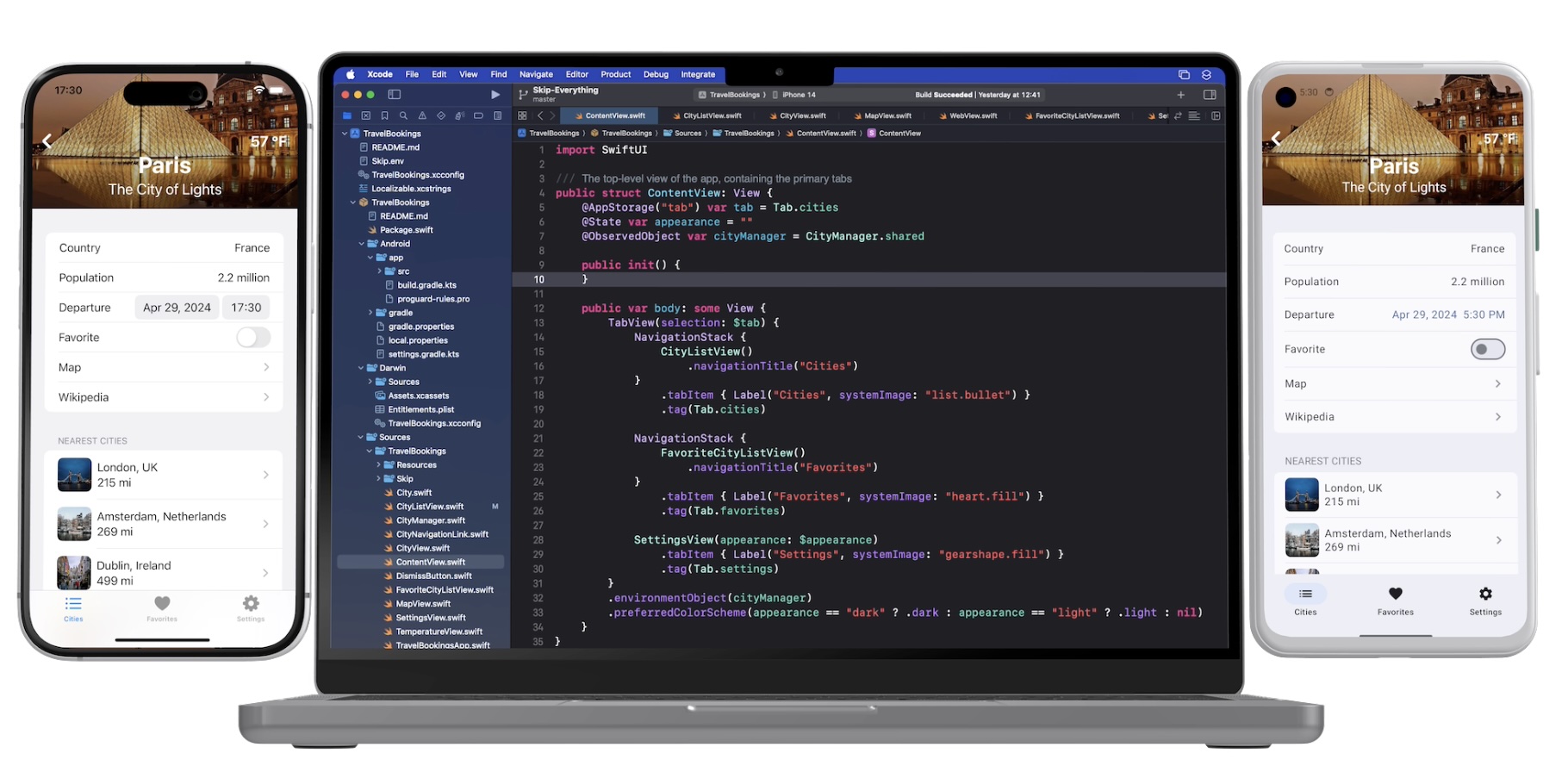
Fully Native Cross-Platform Swift Apps

Screenshot

In our series on using native Swift on Android, we have covered the basics of the Swift-Android toolchain in Part 1, bridging between compiled Swift and Kotlin in Part 2, and the creation of a cross-platform app with a shared Swift model layer in Part 3.

We are pleased to unveil the culmination of all of this work: Skip 1.5 now has the ability to create a 100% native Swift and SwiftUI app for both iOS and Android! You can now enjoy the safety, efficiency, and expressiveness of pure Swift throughout your entire cross-platform app, including the ability to tap into the vast ecosystem of Swift packages to support your app development.

This blog post will go over the process of creating and developing a Swift cross-platform app, explore the underlying technologies, and discuss our current status and next steps.

Ensure that you are on a macOS 14+ machine with Xcode 16, Android Studio 2025, and Homebrew installed.

First, create and launch an Android emulator for testing.

Next, open Terminal and type the following commands to install Skip and the native Swift-Android toolchain.

$ brew install skiptools/skip/skip
$ skip upgrade
$ skip android sdk install

Verify that everything is working with an additional Terminal command:

$ skip checkup --native

You’re now ready to create your first fully native cross-platform Swift app:

$ skip init --native-app --open-xcode --appid=bundle.id.HowdySkip howdy-skip HowdySkip

Assuming the app initialized successfully, your project will open in Xcode. Run the app against an iPhone simulator destination (the first build may take some time) and your app will launch on both the iOS simulator and the running Android emulator at the same time!

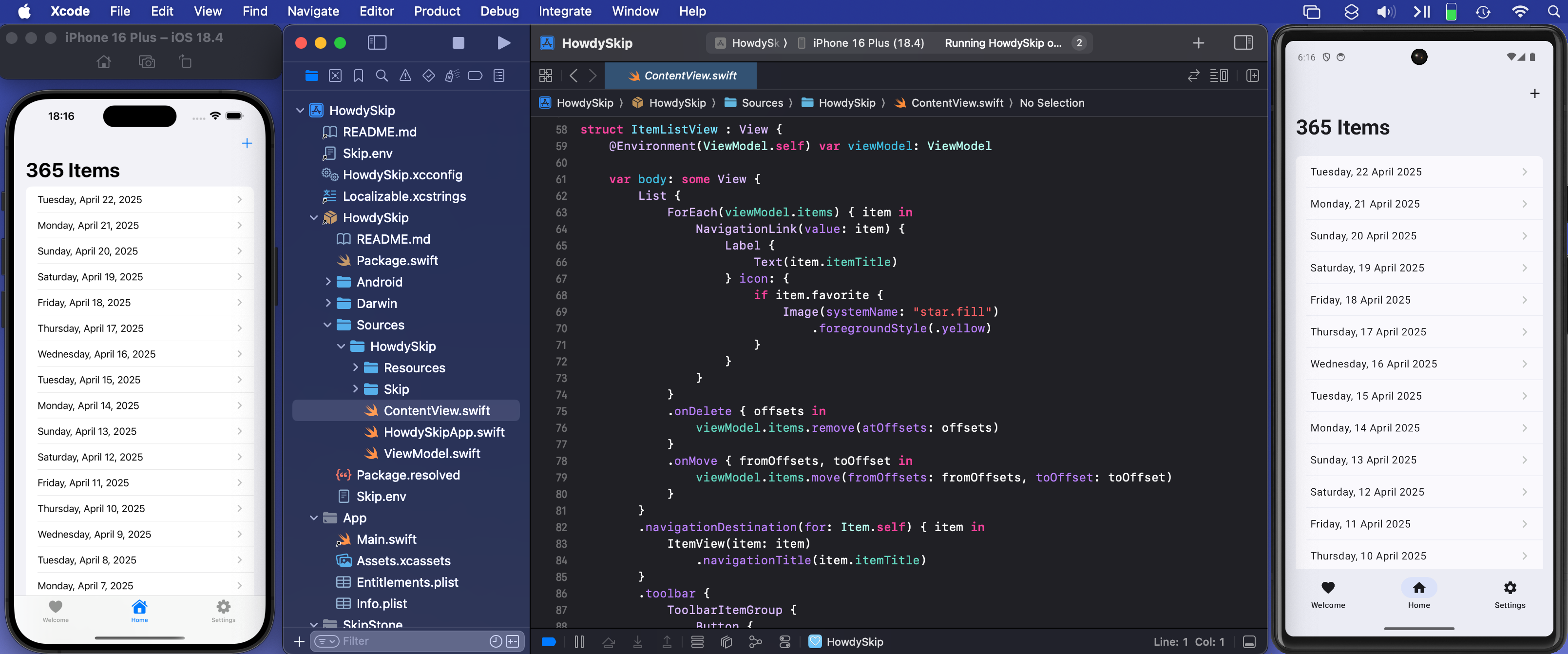
The skip init command creates a template app to get you started. It is a TabView containing a “Welcome” view, a list of editable and re-orderable “Items”, and a “Settings” view:

Screenshot of the Howdy Swift native app Welcome Tab

Rather than importing SwiftUI, you will notice that the Sources/HowdySkip/ContentView.swift file instead imports SkipFuseUI. When building for iOS, this simply redirects to a SwiftUI import. Skip’s philosophy is to not intrude on the iOS side of the application: on Darwin platforms you are still using direct, non-intermediated SwiftUI, just as if you were building an app without Skip at all.

On Android, however, the SkipFuseUI module bridges the SwiftUI API onto Jetpack Compose, Android’s modern Kotlin UI toolkit. It does this through the intermediate SkipUI module. Bridging to pure Jetpack Compose gives Android users a fully native user experience rather than the uncanny-valley replica generated by many cross-platform frameworks.

Diagram of Skip's Swift-on-Android build process

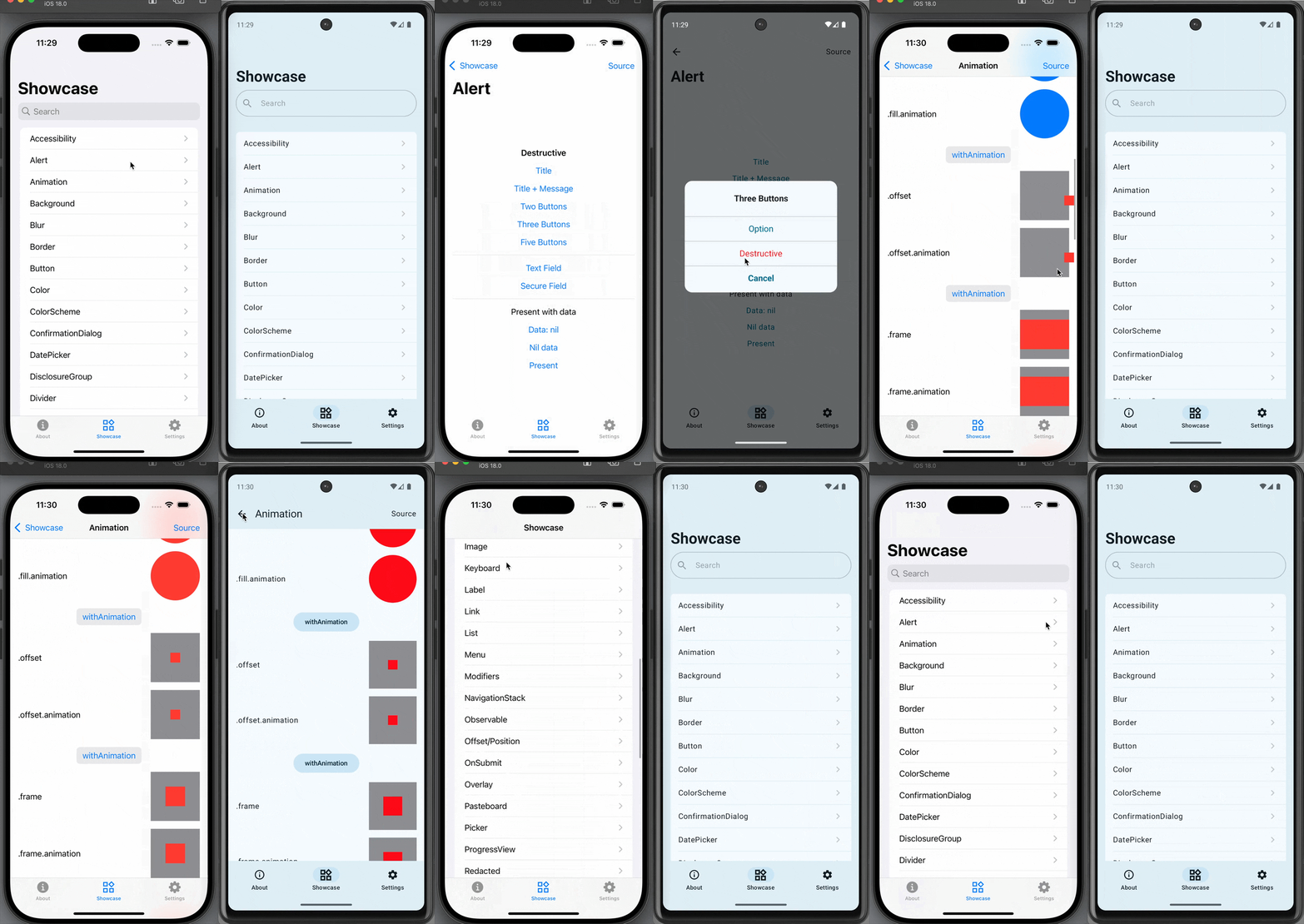
Consult the SkipUI module’s documentation for a listing of currently-supported SwiftUI constructs on Android. You can also examine the ShowcaseFuse cross-platform sample app, which displays and exercises most supported SwiftUI components:

Screen recording

The “Items” tab displays an editable list of items which are managed by Sources/HowdySkip/ViewModel.swift, which handles loading and saving the list of items to a simple JSON file. This code uses standard Foundation types (URL, Data, Date, FileManager, JSONEncoder, JSONDecoder, etc.) to handle the management and persistence of the items. Note that unlike the SwiftUI in ContentView, none of this code is bridged into Kotlin: it is using the Apple swift-foundation types directly, just as on iOS.

Screenshot of the Howdy Swift native app List Tab

Despite only using native Foundation types, you will notice that ViewModel.swift imports SkipFuse. Just as SkipFuseUI bridges your UI to Android, SkipFuse bridges model-layer code. We use it here to enable our @Observable view model to communicate changes to the Jetpack Compose user interface. This is discussed further in Part 2 of the series. You generally don’t need to be concerned with the details other than to remember to import SkipFuse (or SkipFuseUI) any time you implement an @Observable.

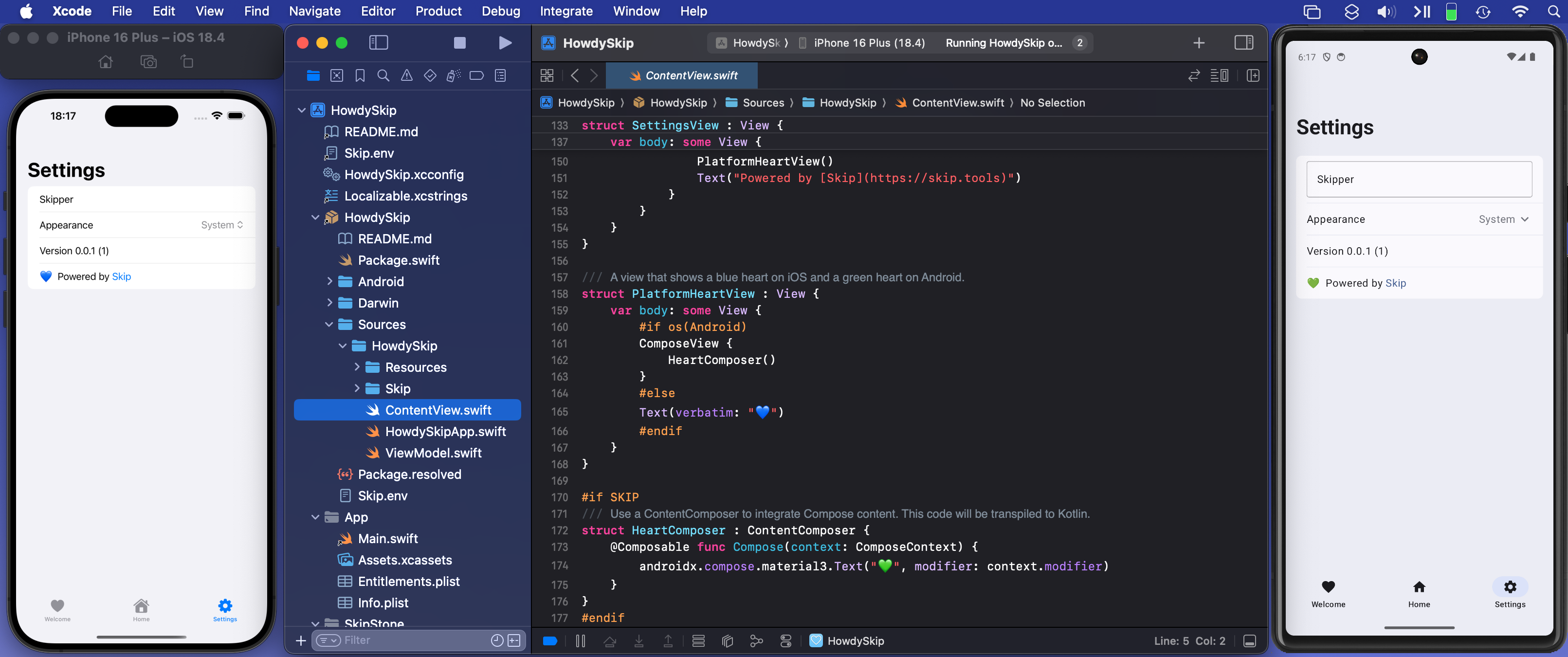
The final tab of the sample app is the “Settings” screen. This exposes various settings and displays some information about the app. It also presents a little heart emoji, which is blue on iOS and green on Android.

Screenshot of the Howdy Swift native app Settings Tab

We use the green heart emoji to demonstrate a powerful feature of Skip: the ability to embed code that directly calls Kotlin and Jetpack Compose APIs! Examining the SettingsView in ContentView.swift, you will see the inclusion of a PlatformHeartView, whose implementation looks like this:

/// A view that shows a blue heart on iOS and a green heart on Android.
struct PlatformHeartView : View {
var body: some View {
#if !os(Android)
Text(verbatim: "💙")
#else
ComposeView {
HeartComposer()
}
#endif
}
}
#if SKIP
/// Use a ContentComposer to integrate Compose content. This code will be transpiled to Kotlin.
struct HeartComposer : ContentComposer {
@Composable func Compose(context: ComposeContext) {
androidx.compose.material3.Text("💚", modifier: context.modifier)
}
}
#endif

What is going on here? Notice that on Android, we’re rendering the heart with a ComposeView, a special SwiftUI view for including Jetpack Compose content in the form of a ContentComposer.

/// Encapsulation of Composable content.
public protocol ContentComposer {
@Composable func Compose(context: ComposeContext)
}

But how can we define @Composable functions and call Android APIs from within our native Swift code?

The magic lies in Skip’s ability to transpile Swift code into Kotlin, and SkipFuse’s ability to bridge between Kotlin and your compiled Swift. Any code in a #if SKIP block will be transformed into the equivalent Kotlin, so it is free to call other Kotlin and Java APIs directly. The generated #if SKIP Kotlin will also be automatically bridged so that you can call it from your native Swift.

Diagram of Skip's custom Compose view embedding

Screen recording

The ability to effectively embed Kotlin code is immensely powerful. It not only provides direct access Jetpack Compose and the Android SDK, but also enables you to tap into the complete Android ecosystem of libraries through Kotlin and Java dependencies.

Of course, using native Swift allows you to take advantage of the vast and growing ecosystem of available Swift packages as well. In our post on Bringing Swift Packages to Android we introduced the swift-everywhere.org site that tracks packages that are successfully building for Android. Since that post, community members have been implementing Android support, bringing the number of known packages that can be used on Android to 2,240! Popular projects like Alamofire, flatbuffers, SwiftSoup, swift-protobuf, and swift-sqlcipher (just to name a few) can be added directly to your app and used in the same way on both iOS and Android.

Skip’s unique ability to directly call both Swift and Kotlin/Java APIs separates it from most cross-platform development frameworks, where integrating with the host system often requires bespoke adapters and extra layers of indirection.

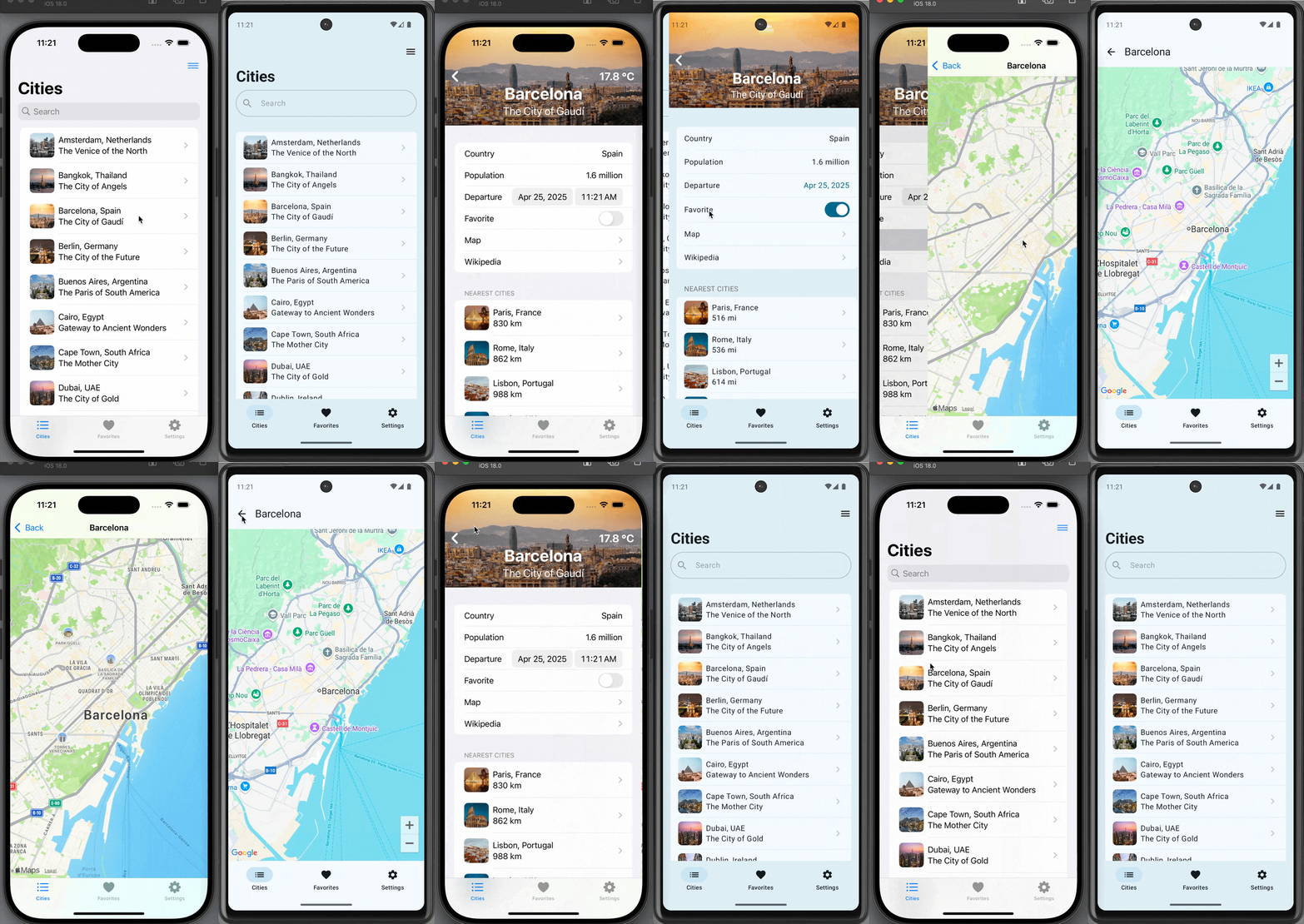
As a demonstration and validation of this technology, we have published one of our sample apps, Skip Notes, to both the Google Play Store and Apple App Store. This fully native Swift app integrates with the swift-sqlcipher database library to provide persistence for a simple list of notes.

Get it on the Google Play Store Get it on the Apple App Store {: .centered }

Despite being generally available, Skip’s native support is currently a technology preview. We are working on updating our documentation, finding and squashing remaining bugs and limitations, reducing build times, and generating smaller Android binaries. Even as a preview, however, you can build complete, production-ready cross-platform Swift apps, as Skip Notes demonstrates.

Cross-platform Swift and SwiftUI have been a dream of ours for a long time. We are immensely excited about the possibilities this unlocks for creating truly best-in-class apps for both iOS and Android from a single codebase!

Swift Everywhere: Bringing Swift Packages to Android

Swift Android Logo {: style=“text-align: center; width: 200px; margin: auto;”}
  • Table of contents {:toc}

In recent weeks, the Skip team has submitted patches to numerous Swift projects to add Android support to their packages. We’ve been tracking the progress of Android build-ability on our swift-everywhere.org web site, which catalogs a list of many popular Swift packages and whether they compile for Android. At the time of writing, nearly two thousand Swift packages are building successfully for Android, with more being added every day.

This article will go over what our experience porting Swift packages has taught us, and how you can apply this knowledge to turn your parochial Apple-only Swift package into a universal multi-platform package that can build for not just iOS and macOS, but also for Android.

What sorts of Swift packages are good candidates for Android? The best litmus test is whether the package offers general-purpose functionality, as opposed to having an integral dependency on iOS-specific frameworks. Some examples of good candidates are:

  • Business logic
  • Algorithms and generic data structures
  • Networking utilities
  • Online web service and API clients
  • Data persistence
  • Parsers and formatters

On the flip side, examples of packages that would be challenging to bring to Android might be:

  • Custom UIKit components
  • HealthKit, CarPlay, Siri integration libraries
  • Other Apple-specific *Kit library integrations

Now, just because a Swift package is designed to work with an Apple-specific framework doesn’t mean that it is impossible to port to Android. It just means that it would be a signifiant amount of work and involve creating a bridge to the equivalent Kotlin or Java framework. This is by all means possible – and will be the topic of a future post – but the subject of this article is how to bring naturally portable Swift packages to Android.

Say you have a conventional Swift package that contains a Package.swift file at the root and has the usual Sources/ and (hopefully) Tests/ folders that contain the individual targets and source files.

Does running swift build and swift test in the package directory work from the Terminal? If so, then you already have a cross-platform package that works on multiple platforms: iOS and macOS! That, by itself, is a good sign that your package might be suitable for Android. Many frameworks that are available on iOS are not present on macOS, so either your package doesn’t use too many iOS frameworks, or it is smart enough to only reference them conditionally (more on that below). But how do we build and test for Android?

First, install Skip and the native Android SDK by following the instructions in our documentation. Then try to build your Swift package with the Android toolchain. The very abbreviated quick start looks like:

$ brew install skiptools/skip/skip
skip was successfully installed!
$ skip android sdk install
[✓] Install Swift Android SDK (2.4s)
$ cd MySwiftPackage/
$ skip android build
Building for debugging...
[0/2] Write sources
[4/4] Emitting module DemoPackage
Build complete! (1.85s)

If you see “Build complete!” then congratulations! Your package already builds for Android, and you can move on to the Testing section. But if you encounter errors from the build command, you will need to port your package over to Android. Read on…

Wikipedia defines porting as the “process of adapting software for the purpose of achieving some form of execution in a computing environment that is different from the one that a given program (meant for such execution) was originally designed for”.

In other words, you made your Swift package with iOS in mind, and now you want it to work on Android. The following sections will go over some of the most common issues you may hit when first trying to build your package on this new platform.

Conditionally Importing and Using Platform-Specific Modules

Section titled “Conditionally Importing and Using Platform-Specific Modules”

Suppose your Swift package defines an Event protocol with a simple default implementation:

protocol Event {
var dateRange: Range<Date> { get }
var isConfirmed: Bool { get }
}
struct SimpleEvent : Hashable, Codable {
let start, end: Date
let confirmed
}
extension SimpleEvent : Event {
var dateRange: Range<Date> { self.start..<self.end }
var isConfirmed: Bool { confirmed }
}

Your package also includes an extension to implement Event using the iOS EventKit framework, like so:

import EventKit
extension EKEvent : Event {
var dateRange: Range<Date> { self.startDate..<self.endDate }
var isConfirmed: Bool { self.status == .confirmed }
}

EventKit is an Apple-only framework, so when you try to build the package for Android, you will hit an error:

$ skip android build
7 | import EventKit
| `- error: no such module 'EventKit'

The solution to this is simple: wrap any code that references the missing module in #if canImport(EventKit), which conditionally compiles the code only when the specified module is available:

protocol Event {
var dateRange: Range<Date> { get }
var isConfirmed: Bool { get }
}
struct SimpleEvent : Hashable, Codable {
let start, end: Date
let confirmed
}
extension SimpleEvent : Event {
var dateRange: Range<Date> { self.start..<self.end }
var isConfirmed: Bool { confirmed }
}
#if canImport(EventKit)
import EventKit
extension EKEvent : Event {
var dateRange: Range<Date> { self.startDate..<self.endDate }
var isConfirmed: Bool { self.status == .confirmed }
}
#endif

Now you will have all the general functionality of the package available to Android, which you can adapt for any Android-specific data structures you may create in the future.

Consider the following simple utility that fetches a URL and decodes it into an Item struct:

import Foundation
struct Item: Decodable {
let id: Int
let name: String
}
func fetch(_ url: URL) async throws -> Item {
let (data, response) = try await URLSession.shared.data(from: url)
return try JSONDecoder().decode(Item.self, from: data)
}

You may be surprised to see this fail to compile for Android:

$ skip android build
Building for debugging...
Fetcher.swift:9:49: error: type 'URLSession' (aka 'AnyObject') has no member 'shared'
7 |
8 | func fetch(_ url: URL) async throws -> Item {
9 | let (data, response) = try await URLSession.shared.data(from: url)
| `- error: type 'URLSession' (aka 'AnyObject') has no member 'shared'
10 | return try JSONDecoder().decode(Item.self, from: data)
11 | }

This somewhat confusing error message just means that it can’t find the URLSession type, because it isn’t present in the Foundation module on Android.

On Darwin platforms (macOS, iOS, and other Apple operating systems), the Foundation module is an umbrella for a wide variety of functionality. But on other platforms, such as Android and Linux, Foundation is broken up into multiple separate sub-components:

  • FoundationEssentials: All the basic Foundation types: Date, Calendar, URL, IndexSet, etc.
  • FoundationInternationalization: DateFormatter, NumberFormatter, and other localization utilities
  • FoundationNetworking: URLSession, URLCache, and other networking utilities
  • FoundationXML: XMLParser

The solution to this is simple: add a conditional import of FoundationNetworking to any file that uses any networking functionality, like so:

import Foundation
#if canImport(FoundationNetworking)
import FoundationNetworking
#endif
struct Item: Decodable {
let id: Int
let name: String
}
func fetch(_ url: URL) async throws -> Item {
let (data, response) = try await URLSession.shared.data(from: url)
return try JSONDecoder().decode(Item.self, from: data)
}

This will include the required FoundationNetworking module for platforms like Android and Linux that need it, but quietly ignore it on Darwin platforms like iOS and macOS where the networking types are included with the monolithic Foundation framework.

Swift has excellent integration with C, and many useful functions come in from the system’s C library, which is called Darwin on macOS and iOS. Take the simple example of calculating the hypotenuse of a triangle, which uses some math functions brought in from the standard C library:

import Darwin
func hypotenuse(a: Double, b: Double) -> Double {
return sqrt(pow(a, 2) + pow(b, 2))
}

If you try to build this for Android, you will hit the error:

1 | import Darwin
| `- error: no such module 'Darwin'

This is because the Darwin module doesn’t exist for Android. It is instead simply called Android. Again, we solve this with our handy conditional canImport:

#if canImport(Darwin)
import Darwin
#elseif canImport(Android)
import Android
#else
#error("Unknown platform")
#endif
func hypotenuse(a: Double, b: Double) -> Double {
return sqrt(pow(a, 2) + pow(b, 2))
}

In this case, we import either Darwin on iOS and macOS, or Android on Android. Both of these will provide access to the system’s standard C library.

Simple C functions (like pow and sqrt) will generally be surfaced in exactly the same way on Darwin and Android platforms. But the definition of some functions and data structures in the Android C library can sometimes differ in subtle ways. For example, the following code uses the FILE type and fopen and fwrite C functions on Darwin platforms:

import Darwin
let fd: UnsafeMutablePointer<FILE> = fopen("file.txt", "w")
var buffer: [UInt8] = [1, 2, 3]
let count: Int = buffer.withUnsafeBufferPointer { ptr in
fwrite(ptr.baseAddress, MemoryLayout<UInt8>.stride, ptr.count, fd)
}

This will fail to build for Android:

$ skip android build
FileWrite.swift:15:30: error: cannot find type 'FILE' in scope
13 | #endif
14 |
15 | let fd: UnsafeMutablePointer<FILE> = fopen("file.txt", "w")
| `- error: cannot find type 'FILE' in scope
16 | var buffer: [UInt8] = [1, 2, 3]
17 | let count: Int = buffer.withUnsafeBufferPointer { ptr in
FileWrite.swift:18:16: error: value of optional type 'UnsafePointer<UInt8>?' must be unwrapped to a value of type 'UnsafePointer<UInt8>'
16 | var buffer: [UInt8] = [1, 2, 3]
17 | let count: Int = buffer.withUnsafeBufferPointer { ptr in
18 | fwrite(ptr.baseAddress, MemoryLayout<UInt8>.stride, ptr.count, fd)
| |- error: value of optional type 'UnsafePointer<UInt8>?' must be unwrapped to a value of type 'UnsafePointer<UInt8>'
| |- note: coalesce using '??' to provide a default when the optional value contains 'nil'
| `- note: force-unwrap using '!' to abort execution if the optional value contains 'nil'
19 | }
20 |

There are two separate issue here:

  • FILE doesn’t exist on Android, so UnsafeMutablePointer<FILE> must be replaced with OpaquePointer
  • Functions like fwrite that take a file pointer will not accept an optional, and so must be force-unwrapped from their pointer’s rawValue

The following conditional typealias will handle the first issue, and simply force-unwrapping the pointer’s address (which should be valid on all platforms) addresses the second:

#if canImport(Darwin)
import Darwin
#elseif canImport(Android)
import Android
#else
#error("Unknown platform")
#endif
#if os(Android)
typealias Descriptor = OpaquePointer
#else
typealias Descriptor = UnsafeMutablePointer<FILE>
#endif
let fd: Descriptor = fopen("file.txt", "w")
var buffer: [UInt8] = [1, 2, 3]
let count: Int = buffer.withUnsafeBufferPointer { ptr in
fwrite(ptr.baseAddress!, MemoryLayout<UInt8>.stride, ptr.count, fd)
}

Unless you are developing very low-level code that interfaces with the platform’s C library, you will rarely encounter these sorts of issues. But when you do, it is good to know that the solutions tend the be fairly simple. The most difficult part is often just deciphering the compilation failure message.

So now your package builds for Android with the command: skip android build. Amazing!

But you are only halfway there: you need to make sure your code not only builds for Android, but that it actually works. Hopefully, your Swift package includes test cases in the Test/ folder, and running the tests locally on your macOS machine with swift test works. For example, with the swift-algorithms package:

$ swift test
Building for debugging...
[78/78] Linking swift-algorithmsPackageTests
Build complete! (12.67s)
Test Suite 'All tests' started at 2025-01-21 19:25:03.841.
Test Suite 'swift-algorithmsPackageTests.xctest' started at 2025-01-21 19:25:03.842.
Test Suite 'AdjacentPairsTests' started at 2025-01-21 19:25:03.842.
Test Case '-[SwiftAlgorithmsTests.AdjacentPairsTests testEmptySequence]' started.
Test Case '-[SwiftAlgorithmsTests.AdjacentPairsTests testEmptySequence]' passed (0.002 seconds).
Test Case '-[SwiftAlgorithmsTests.AdjacentPairsTests testIndexTraversals]' started.
Test Case '-[SwiftAlgorithmsTests.AdjacentPairsTests testIndexTraversals]' passed (0.002 seconds).
Test Suite 'All tests' passed at 2025-01-21 19:25:05.718.
Executed 212 tests, with 0 failures (0 unexpected) in 1.870 (1.876) seconds

In order to run your tests on Android, you will need to either plug in an Android device (with USB debugging enabled), or else configure and launch an Android emulator, either from the command line or Android Studio).

Once you have your Android development target setup, you can run your package’s test cases with the skip android test command, which will compile the test cases, bundle them up (along with any associated resources), copy them to the Android device or emulator, and then execute the test cases remotely.

For example, for the swift-algorithms package:

% skip android test
[0/1] Planning build
Building for debugging...
[83/84] Linking swift-algorithmsPackageTests.xctest
Build complete! (11.68s)
[✓] Check Swift Package (0.87s)
[✓] Connecting to Android (0.18s)
[✓] Copying test files (0.88s)
Test Suite 'All tests' started at 2025-01-21 21:02:09.086
Test Suite 'swift-algorithms-1C77777B-CEC3-4075-8853-E77CECFCF30B.xctest' started at 2025-01-21 21:02:09.105
Test Suite 'AdjacentPairsTests' started at 2025-01-21 21:02:09.105
Test Case 'AdjacentPairsTests.testEmptySequence' started at 2025-01-21 21:02:09.105
Test Case 'AdjacentPairsTests.testEmptySequence' passed (0.014 seconds)
Test Case 'AdjacentPairsTests.testIndexTraversals' started at 2025-01-21 21:02:09.120
Test Case 'AdjacentPairsTests.testIndexTraversals' passed (0.004 seconds)
Test Suite 'All tests' passed at 2025-01-21 21:02:21.697
Executed 212 tests, with 0 failures (0 unexpected) in 12.579 (12.579) seconds

If there are any test failures, this is where you will delve into the details of your test case, isolate the problem, and apply fixes. There are many reasons why tests may fail, such as assumptions about the filesystem layout. These will need to be examined and resolved on a case-by-case basis.

Once all your tests pass, you’ve successfully brought your Swift package to Android!

Once you have your package building and your tests passing, you will want to ensure that they continue to pass. Maintaining a package that supports multiple platforms can be more challenging than just a single platform, because often when a new feature is implemented or a bug is fixed, the change will only be tested on the platform the developer is currently working with. For example, if you are working on the iOS side of your application and make a bug fix in one of your packages, you may only test the changes on that one platform, but it may inadvertently break something on another platform.

This is where continuous integration (CI) can be useful. If you use GitHub as your package’s source code management system, you can utilize GitHub Actions to automatically build and test your package on multiple platforms whenever you push to the repository or, for example, whenever a pull request is created from a branch or fork.

In order to facilitate Android CI, we provide the swift-android-action, which enables you to build and test your package against Android in a single line of configuration.

The following example of a .github/workflows/ci.yml script will build and test your package on each of macOS, iOS, Linux, and Android whenever a commit is pushed or a PR is created:

name: swift package ci
on:
push:
branches:
- '*'
workflow_dispatch:
pull_request:
branches:
- '*'
jobs:
linux-android:
runs-on: ubuntu-latest
steps:
- uses: actions/checkout@v4
- name: "Test Swift Package on Linux"
run: swift test
- name: "Test Swift Package on Android"
uses: skiptools/swift-android-action@v2
macos-ios:
runs-on: macos-latest
steps:
- uses: actions/checkout@v4
- name: "Test Swift Package on macOS"
run: swift test
- name: "Test Swift Package on iOS"
run: xcodebuild test -sdk "iphonesimulator" -destination "platform=iOS Simulator,name=iPhone 15" -scheme "$(xcodebuild -list -json | jq -r '.workspace.schemes[-1]')"

You can see this workflow in play in many of the packages on GitHub that support Android, such as Skip’s own swift-sqlcipher package.

In this way, you can be assured that once you have done the hard work of getting your package working with Android, it continues to work on all your supported platforms.

Expanding your Swift packages to support platforms beyond iOS may at first seem daunting, but using the advice from this article, you can follow a few simple steps that will put you on the right track:

  1. Setup Skip and the Swift Android SDK
  2. Try to build your package with skip android build
  3. Identify build errors and resolve them with conditional imports and by accommodating platform differences
  4. Set up an Android emulator or device for testing
  5. Test your package with skip android test
  6. Identify test failures and resolve them on a case-by-case basis

This is the sequence we have used to add Android support to dozens of popular Swift packages, such as GraphQL, CryptoSwift, and PromiseKit. With nearly 2,000 Swift packages currently building for Android, we feel the platform has achieved enough critical mass to make Swift an attractive language for many parts of your apps on both major mobile platforms: iOS and Android. And if you have a popular GitHub package that builds for Android, expect it to show up at swift-everywhere.org in the near future!

To learn more about running Swift on Android and how it integrates with Skip’s tools for creating dual-platform mobile apps, please see our ongoing blog series on the topic:

Native Swift on Android, Part 1: Setup, Compiling, Running, and Testing

You may already be familiar with Skip as a tool for bringing your Swift iOS apps to Android. Skip takes a novel transpilation approach, where we integrate with the Xcode build system to convert your Swift code into Kotlin. This allows us to create an Android library for every build of your Swift package, or to launch an Android version of your SwiftUI app on every Xcode Run.

We’ve discussed the advantages of a transpilation-based strategy in the past. But despite the fact that Android is a Java/Kotlin-oriented platform, there are also significant benefits to compiled code. Skip has featured support for integrating with C code on both Android and iOS for a long time. It only makes sense that our transpiled Swift code should also integrate with compiled Swift code.

Swift Android Logo {: style=“text-align: center; width: 200px; margin: auto;”}
And so we are excited to announce the first technology preview of a native Swift toolchain and driver for Android! This toolset enables developers to build and run Swift executables and test cases on a connected Android device or emulator.

On a macOS development machine with Xcode and Homebrew installed, you can install the Swift 6.0 Android toolchain by opening a terminal and running:

brew install skiptools/skip/swift-android-toolchain@6.0

This will download the Swift Android SDK, along with all the dependencies it needs to build, run, and test Swift packages on Android.

If you’re an existing Skip user, make sure to also update your skip copy to version 1.1.1+:

skip upgrade

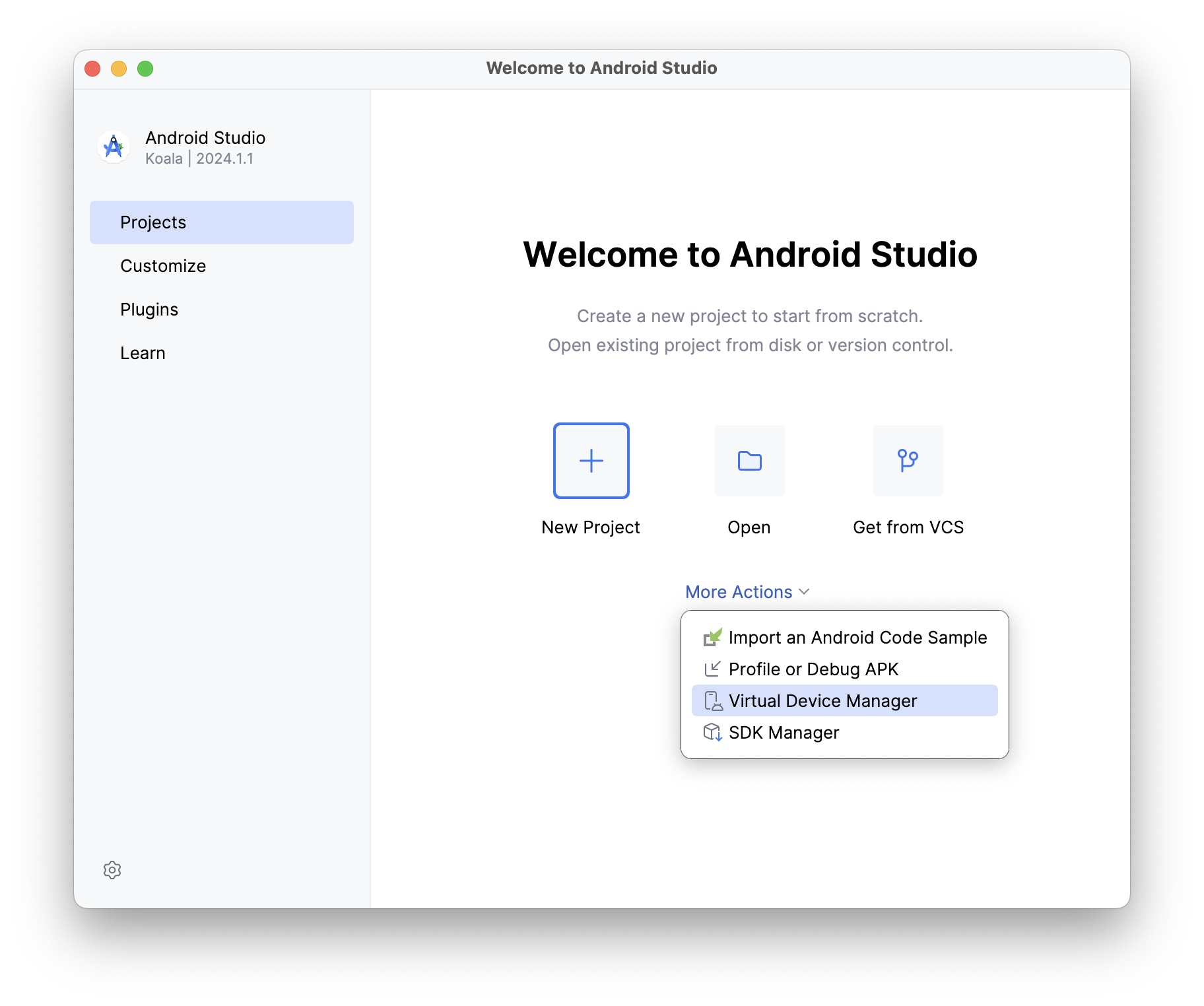
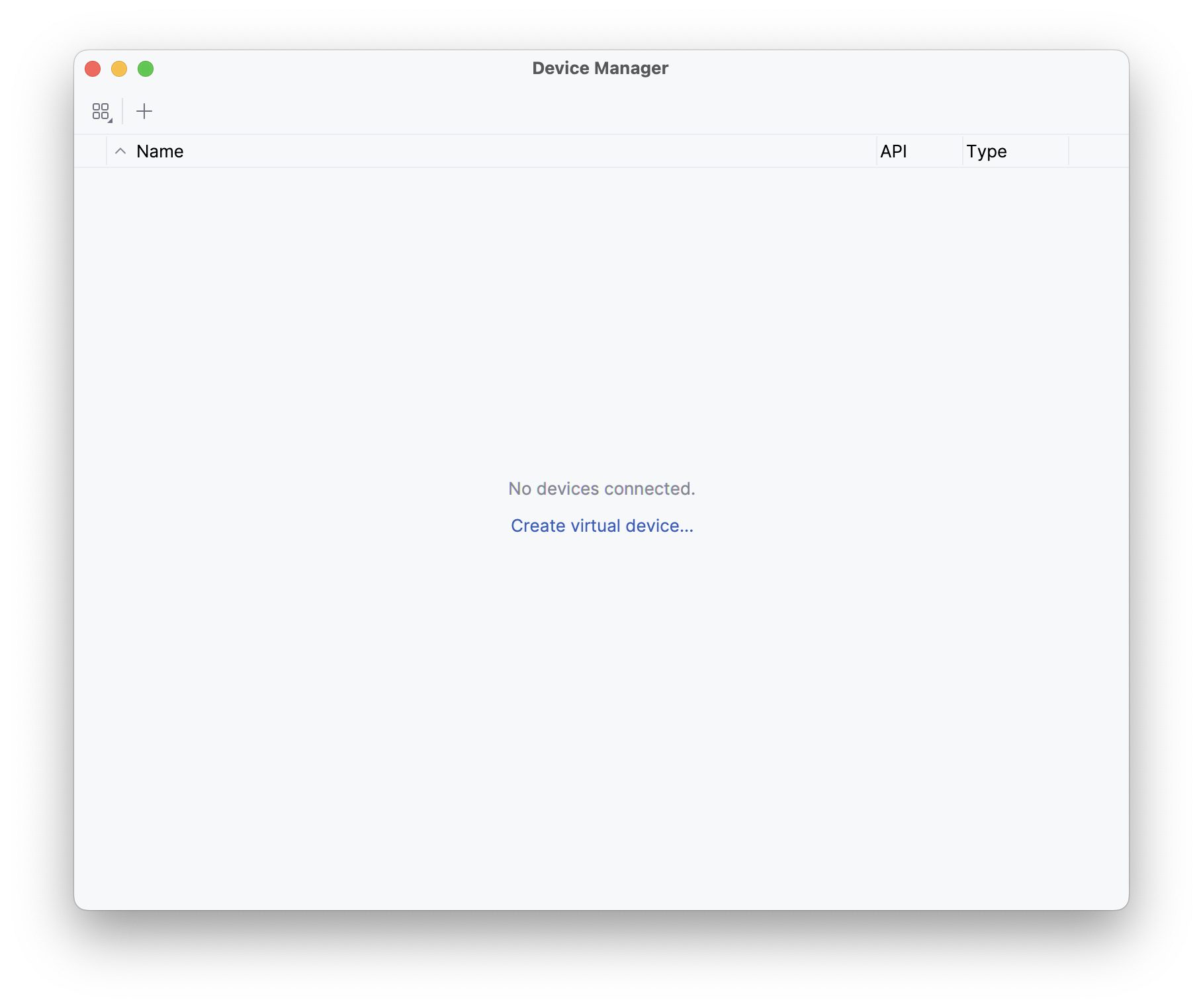
Unless you have an Android device handy, you will need to install the Android emulator in order to run executables and test cases in a simulated Android environment. The simplest way to do this is to download and install Android Studio, then launch it and open the “Virtual Device Manager” from the “More Actions” (or ellipsis menu) of the “Welcome to Android Studio” dialog. On the resulting “Device Manager” screen, select “Create virtual device”.

Android Emulator Setup 1: Welcome Screen Android Emulator Setup 2: Device Manager

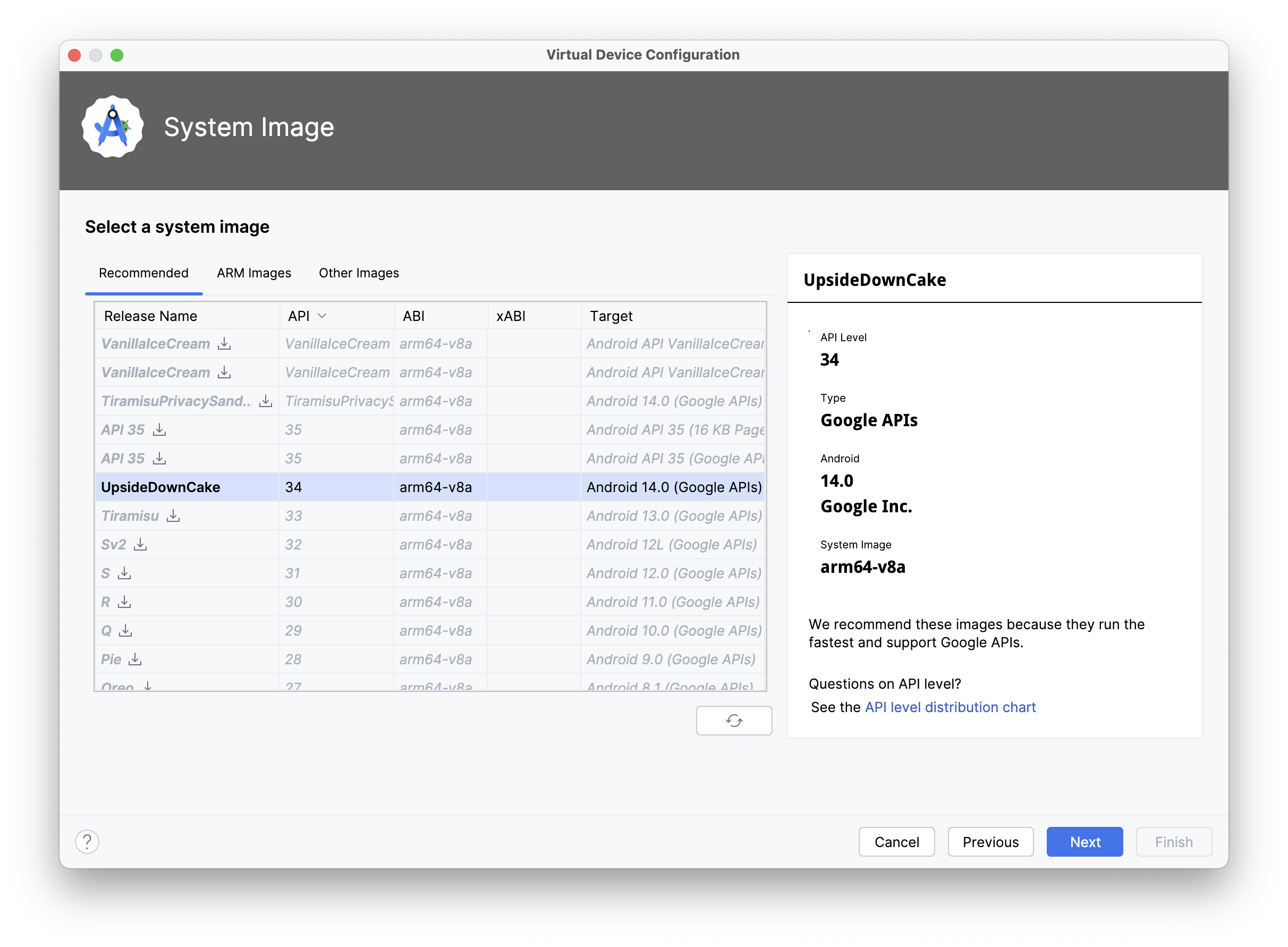
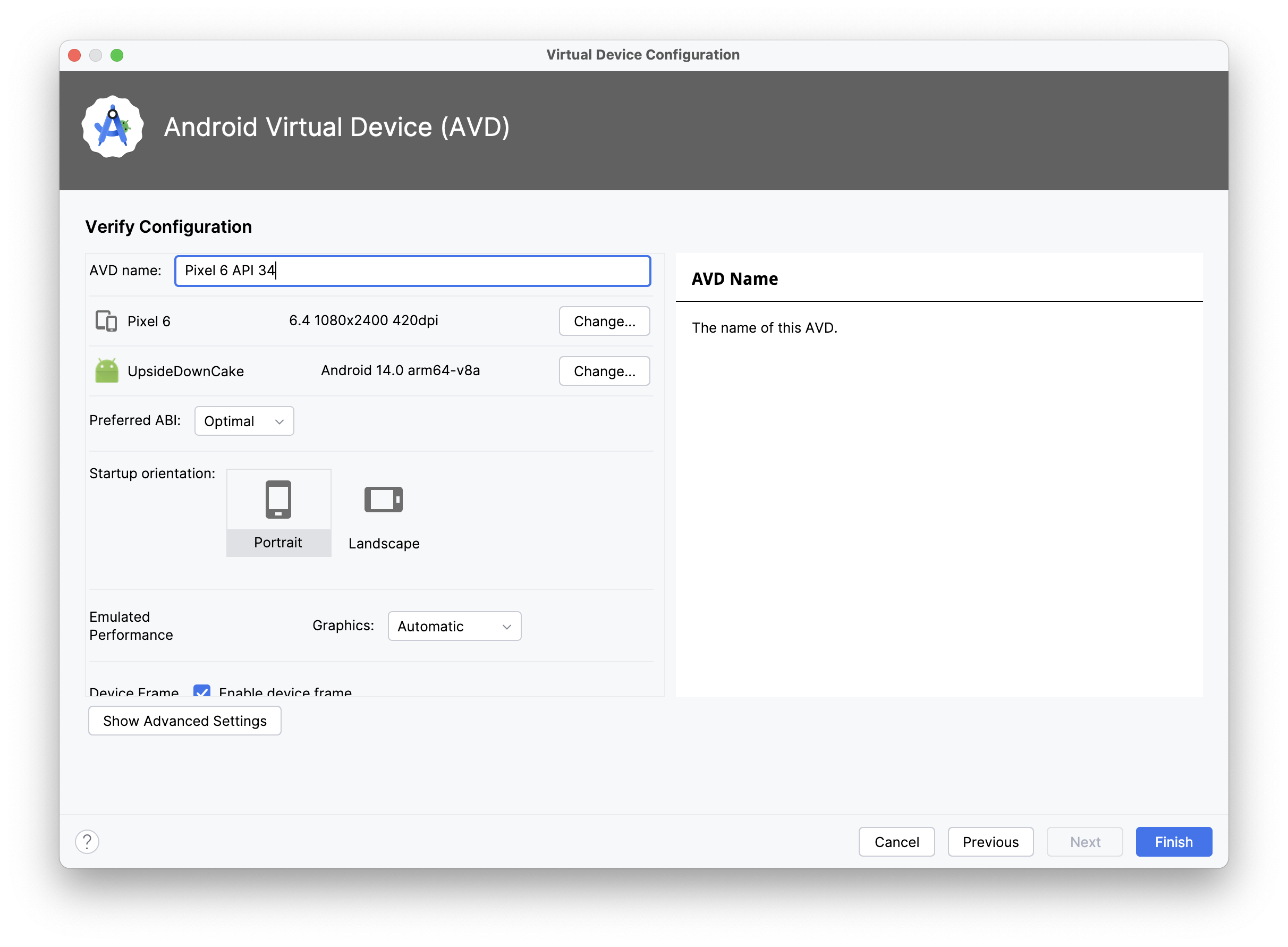
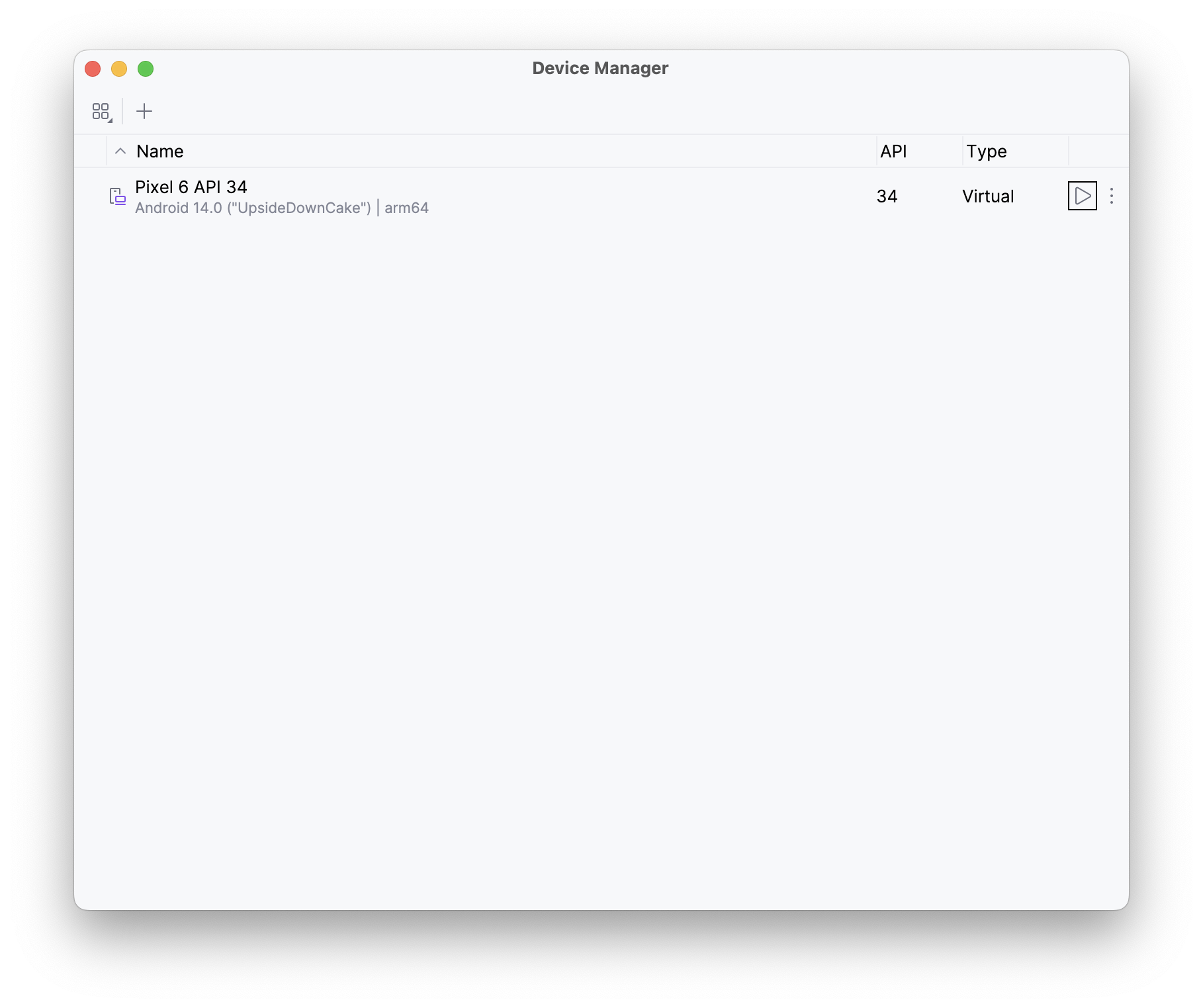
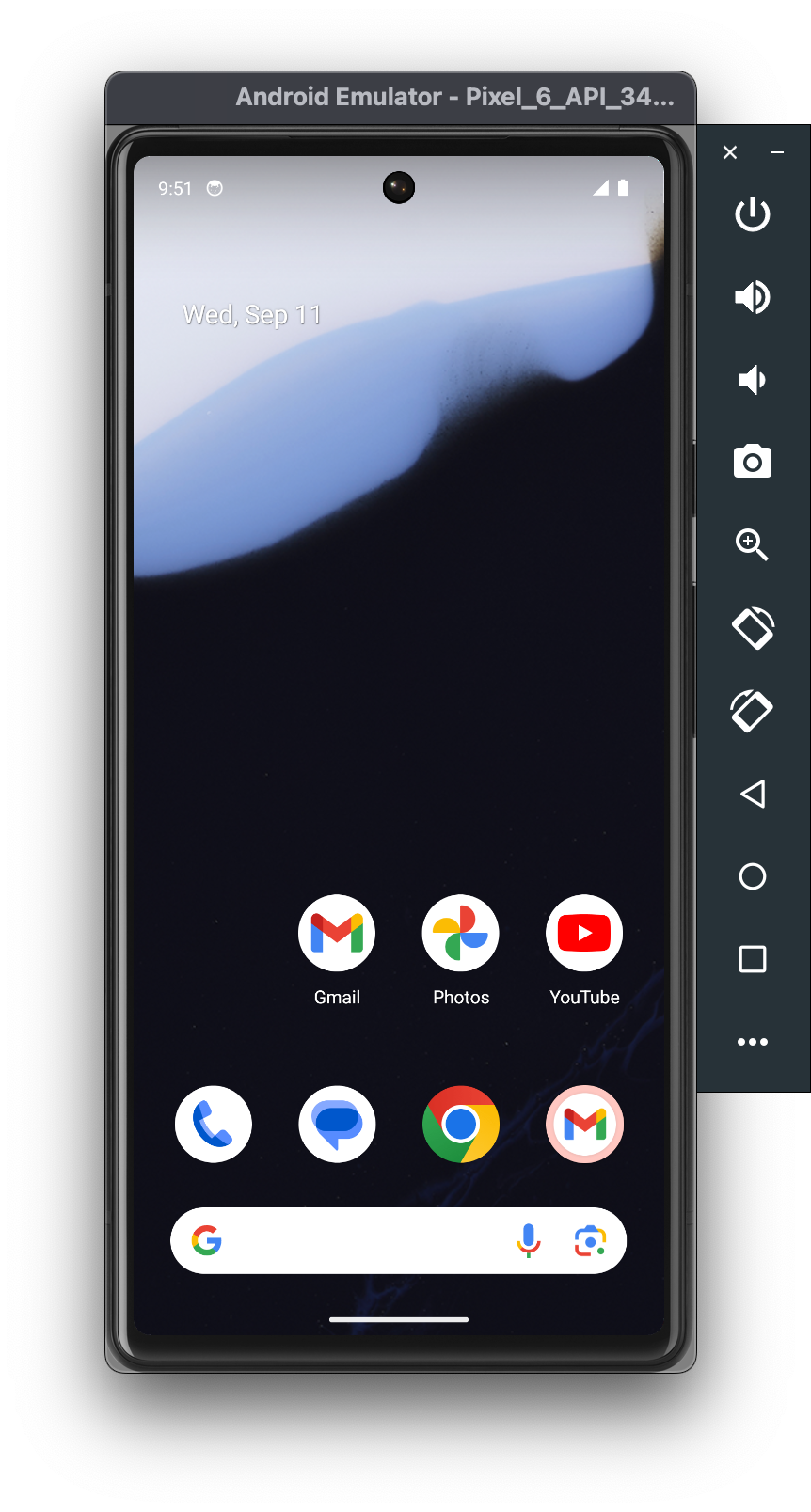
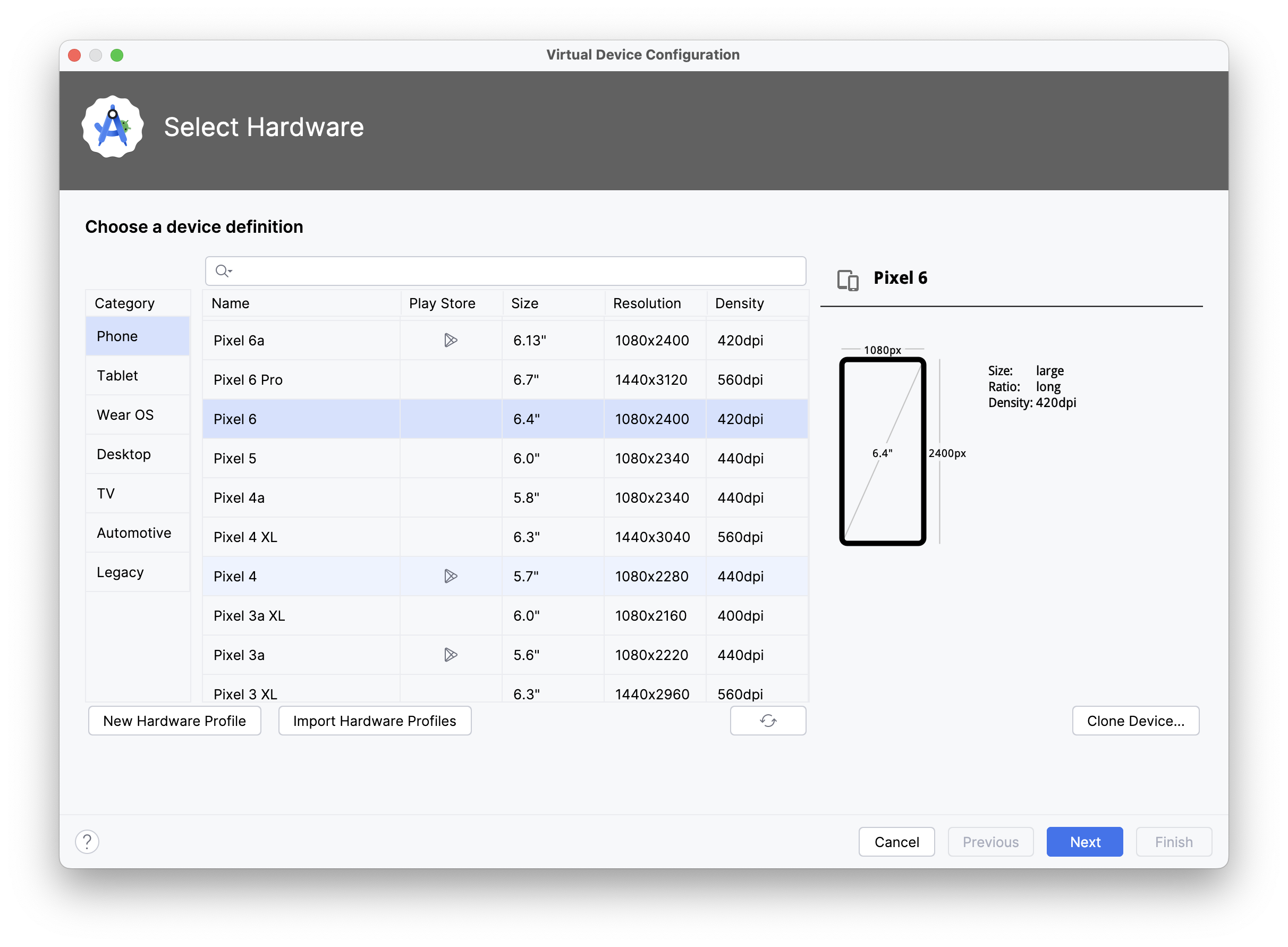
On the “Select Hardware” screen, select a device (e.g., “Pixel 6”) and then on the “Select a system image” screen select one of the recommended images (e.g., “UpsideDownCake”, a.k.a. API 34), and then on the next screen name the device and select “Finish”. When you return to the “Device Manager” screen, you will see a new device (like “Pixel 6 API 34”), which you can then launch with the triangular play button. A little window titled “Android Emulator” will appear and the operating system will boot.

Android Emulator Setup 3: Select Hardware Android Emulator Setup 4: Select System Image Android Emulator Setup 5: Verify Connfiguration
Android Emulator Setup 6: Device Manager Android Emulator Setup 6: Running Emulator

Running Swift “Hello World” on Android

Section titled “Running Swift “Hello World” on Android”

Now that you have everything set up and have launched an Android emulator (or connected a physical Android device with developer mode enabled), it’s time to run some Swift!

Open a terminal and create a new Swift command-line executable called “HelloSwift”:

% mkdir HelloSwift
% cd HelloSwift
% swift package init --type=executable
Creating executable package: HelloSwift
Creating Package.swift
Creating Sources/main.swift

Just to make sure it works on macOS, run the program with the standard swift run command:

% swift run HelloSwift
Building for debugging...
Build of product 'HelloSwift' complete! (1.80s)
Hello, world!

And now, we will build and run it on the Android emulator (or device) using the Swift Android driver, which we include as part of the skip tool that was installed along with the toolchain:

% skip android run HelloSwift
Building for debugging...
Build complete! (10.90s)
[✓] Check Swift Package (0.68s)
[✓] Connecting to Android (0.05s)
[✓] Copying executable files (0.25s)
Hello, world!

Viola! There’s Swift running on Android. And just to prove to that we are really running on a different host, edit the Sources/main.swift file with your favorite editor (or run xed Sources/main.swift to edit it in Xcode), and add a platform check:

#if os(Android)
print("Hello, Android!")
#elseif os(macOS)
print("Hello, macOS!")
#else
print("Hello, someone other platform…")
#endif

Then run it on both macOS and Android:

% swift run HelloSwift
Building for debugging...
Build of product 'HelloSwift' complete! (0.47s)
Hello, macOS!
% skip android run HelloSwift
Building for debugging...
Build complete! (0.89s)
[✓] Check Swift Package (0.23s)
[✓] Connecting to Android (0.04s)
[✓] Copying executable files (0.23s)
Hello, Android!

Command-line tools are fun, but to really exercise Swift on Android, we want to be able to run test suites. This is how developers interested in creating cross-platform frameworks will be able to check for – and resolve – issues with their Swift code arising from platform differences.

Fortunately the skip android driver includes not just the run command, but also the test command, which will connect to the Android emulator/device and run through an XCTest test suite in the same way as swift test does for macOS.

To demonstrate, we can run the test suite for Apple’s swift-algorithms package, to make sure it runs correctly on Android:

% git clone https://github.com/apple/swift-algorithms.git
Cloning into 'swift-algorithms'...
Resolving deltas: 100% (1054/1054), done.
% cd swift-algorithms
% skip android test
Fetching https://github.com/apple/swift-numerics.git from cache
Fetched https://github.com/apple/swift-numerics.git from cache (0.87s)
Computing version for https://github.com/apple/swift-numerics.git
Computed https://github.com/apple/swift-numerics.git at 1.0.2 (0.57s)
Creating working copy for https://github.com/apple/swift-numerics.git
Working copy of https://github.com/apple/swift-numerics.git resolved at 1.0.2
Building for debugging...
[92/93] Linking swift-algorithmsPackageTests.xctest
Build complete! (25.91s)
[✓] Check Swift Package (0.74s)
[✓] Connecting to Android (0.06s)
[✓] Copying test files (0.27s)
Test Suite 'All tests' started at 2024-09-10 20:24:17.770
Test Suite 'swift-algorithms-C7A0585A-0DC2-4937-869A-8FD5E482398C.xctest' started at 2024-09-10 20:24:17.776
Test Suite 'AdjacentPairsTests' started at 2024-09-10 20:24:17.776
Test Case 'AdjacentPairsTests.testEmptySequence' started at 2024-09-10 20:24:17.776
Test Case 'AdjacentPairsTests.testEmptySequence' passed (0.001 seconds)
Test Case 'WindowsTests.testWindowsSecondAndLast' started at 2024-09-10 20:24:20.480
Test Case 'WindowsTests.testWindowsSecondAndLast' passed (0.0 seconds)
Test Suite 'WindowsTests' passed at 2024-09-10 20:24:20.480
Executed 8 tests, with 0 failures (0 unexpected) in 0.004 (0.004) seconds
Test Suite 'swift-algorithms-C7A0585A-0DC2-4937-869A-8FD5E482398C.xctest' passed at 2024-09-10 20:24:20.480
Executed 212 tests, with 0 failures (0 unexpected) in 2.702 (2.702) seconds
Test Suite 'All tests' passed at 2024-09-10 20:24:20.480
Executed 212 tests, with 0 failures (0 unexpected) in 2.702 (2.702) seconds

Everything passes. Hooray!

Not every package’s tests will pass so easily: Android is based on Linux – unlike the Darwin/BSD heritage of macOS and iOS – so there may be assumptions your code makes for Darwin that don’t hold true on Linux. Running through a comprehensive test suite is the best way to begin isolating, and then addressing, these platform differences.

Command line executables and unit tests are all well and good, but “Hello World” is not an app. To create an actual Android app, with access to device capabilities and a graphical user interface, you need to work with the Android SDK, which is written in Java and Kotlin. And you need to package and distribute the app in Android’s own idiomatic way, with self-contained libraries embedded in the application’s assembly.

This is where integration with Skip’s broader ecosystem comes into play. Additional installments of this series explore Skip’s system for transparently bridging compiled Swift to Java, Kotlin, and transpiled Swift - including Skip’s existing SwiftUI support for Android. This allows the best of all worlds: transpiled Swift to talk to Android libraries, SwiftUI on top of Jetpack Compose, and business logic and algorithms implemented in compiled Swift!

Screenshot

Additional posts in the native Swift on Android series:

The Swift toolchain for Android is the culmination of many years of community effort, in which we (the Skip team) have played only a very small part.

Even before Swift was made open-source, people have been tinkering with getting it running on Android, starting with Romain Goyet’s “Running Swift code on Android” attempts in 2015, which got some basic Swift compiling and running on an Android device. A more practical example came with Geordie J’s “How we put an app in the Android Play Store using Swift” in 2016, where Swift was used in an actual shipping Android app. Then in 2018, Readdle published “Swift for Android: Our Experience and Tools” on integrating Swift into their Spark app for Android. These articles provide valuable technical insight into the mechanics and complexities involved with cross-compiling Swift for a new platform.

In more recent years, the Swift community has had various collaborative and independent endeavors to develop a usable Swift-on-Android toolchain. Some of the most prominent contributors on GitHub are @finagolfin, @vgorloff, @andriydruk, @compnerd, and @hyp. Our work merely builds atop of their tireless efforts, and we expect to continue collaborating with them in the hopes that Android eventually becomes a fully-supported platform for the Swift language.

Looking towards the future, we are eager for the final release of Swift 6.0, which will enable us to publish a toolchain that supports all the great new concurrency features, as well as the Swift Foundation reimplementation of the Foundation C/Objective-C libraries, which will give us the the ability to provide better integration between Foundation idioms (bundles, resources, user defaults, notifications, logging, etc.) and the standard Android patterns. A toolchain is only the first step in making native Swift a viable tool for building high-quality Android apps, but it is an essential component that we are very excited to be adding to the Skip ecosystem.

Skip 1.0 Release

Screenshot

We’re thrilled to announce the release of Skip 1.0!

Skip brings Swift app development to Android. Share Swift business logic, or write entire cross-platform apps in SwiftUI.

Skip is the only tool that enables you to develop genuinely native apps for both major mobile platforms with a single codebase. Under the hood, it uses the vendor-recommended technologies on each OS: Swift and SwiftUI on iOS, Kotlin and Compose on Android. So your apps don’t just “look native”, they are native, with no additional resource-hogging runtime and no uncanny-valley UI replicas.

Skip also gives you complete access to platform libraries. Directly call any Swift or Objective C API on iOS, and any Kotlin or Java API on Android - no complex bridging required!

Skip has been in development for over a year. It has an enthusiastic community of users developing a wide range of apps and continually improving Skip’s ecosystem of cross-platform open source libraries.

The Flutter Kerfuffle

News recently broke that Google is laying off members of the Dart and Flutter teams. At the same time that Microsoft is ending Xamarin support, many Flutter users are left wondering about the future of the technology stack on which they’ve built their apps.

For what it’s worth, we don’t buy into the speculation that Flutter is about the be killed off. While we believe that Skip has the correct approach to cross-platform mobile development, Flutter is an excellent product with a devoted community. A recent post by an insider notes that the Google layoffs were broad and didn’t single out the Flutter and Dart teams. Nevertheless, this episode emphasizes the need to always consider the ejectability of the core technologies you use.

“And every one who hears these sayings of Mine and does not do them will be likened to a foolish man who built his house on the sand.”

A software framework is said to be ejectable if you can remove it without completely breaking your app. Ejectability is not binary: having to remove a given framework might only require you to excise certain features, and some frameworks are easier to replace in our apps than others.

Unfortunately, most cross-platform development tools are not ejectable to any degree. If official Flutter support were end-of-lifed, there would not be any path for Flutter codebases to migrate to another technology stack. Dart is a nice language and Widgets are cool, but Apple is not about to transition from Swift and SwiftUI, nor Android from Kotlin and Jetpack Compose. Languages like Dart and Javascript will forever be “alien” on both iOS and Android, just as Swift and Kotlin will be the primary, supported, and vendor-recommended languages for the foreseeable future.

Flutter apps would continue to work, and the community would likely maintain the Flutter engine and libraries for quite some time. But the pace of integration with the latest Android and iOS features would slow, and businesses who care about the long-term prospects for their apps would look to move on. Unfortunately, their only option would be something seasoned developers avoid for good reason: a complete re-write.

To be clear, we do not believe that Flutter support is going to end any time soon, and the same goes for other popular cross-platform solutions like React Native. But you should also not take the decision to use these frameworks lightly, because they are not ejectable. If support unexpectedly ends - or if a new Apple or Android platform or feature arrives that these non-native frameworks are not able to integrate with - you have no off-ramp.

Skip’s approach to cross-platform development is fundamentally different. You work in a single codebase, but Skip creates fully native apps for each platform: Swift and SwiftUI on iOS, and Kotlin and Compose on Android. This is in keeping with the plainly-stated, unambiguous advice from the platform vendors themselves:

SwiftUI is the preferred app-builder technology -Apple

Jetpack Compose is Android’s recommended modern toolkit -Google

A cross-platform Skip app is a modern iOS app. Your shared code is written in Xcode using Swift and SwiftUI. For example, here is a simple weather model:

import Foundation
struct Weather : Decodable {
let latitude: Double
let longitude: Double
let time: Double
let timezone: String
}
extension Weather {
/// Fetches the weather from the open-meteo API
static func fetch(latitude: Double, longitude: Double) async throws -> Weather {
let url = URL(string: "https://api.open-meteo.com/v1/forecast?latitude=\(latitude)&longitude=\(longitude)&current_weather=true")!
var request = URLRequest(url: url)
let (data, response) = try await URLSession.shared.data(for: request)
return try JSONDecoder().decode(Weather.self, from: data)
}
}

At build time, the Skip tool integrates with Xcode to transpile your iOS codebase into a native Android app written in Kotlin.

As you can see in the sample above, your Swift code does not require any dependencies on Skip. Even integrating Android customization into your app is accomplished without Skip libraries. If you remove all traces of Skip, your iOS app will continue to build and run in Xcode exactly as before.

On the Android side, the Kotlin source code and artifacts that Skip generates are yours, regardless of whether you continue to use Skip. Unlike the iOS app, the translated Android app does rely on Skip libraries to mirror the Foundation, SwiftUI and other Apple APIs that your iOS code likely uses. These libraries, however, are free and open source. Critically, they are not a “runtime” or “engine”. You can continue to use them - or not - without hampering your ability to expand the app and integrate new Android features.

Here is the Kotlin that Skip generates from the sample weather model above. It is not significantly different than Kotlin you’d write by hand. It is longer than the source Swift only because Kotlin does not have built-in JSON decoding, so Skip must add it. (SwiftUI code translated to Skip’s Compose-based UI library for Android is much less idiomatic. If you stopped using Skip you’d likely want to migrate to pure Compose over time, but there would be no immediate need to do so.)

import skip.foundation.*
internal class Weather: Decodable {
internal val latitude: Double
internal val longitude: Double
internal val time: Double
internal val timezone: String
constructor(latitude: Double, longitude: Double, time: Double, timezone: String) {
this.latitude = latitude
this.longitude = longitude
this.time = time
this.timezone = timezone
}
constructor(from: Decoder) {
val container = from.container(keyedBy = CodingKeys::class)
this.latitude = container.decode(Double::class, forKey = CodingKeys.latitude)
this.longitude = container.decode(Double::class, forKey = CodingKeys.longitude)
this.time = container.decode(Double::class, forKey = CodingKeys.time)
this.timezone = container.decode(String::class, forKey = CodingKeys.timezone)
}
companion object: DecodableCompanion<Weather> {
/// Fetches the weather from the open-meteo API
internal suspend fun fetch(latitude: Double, longitude: Double): Weather = Async.run l@{
val url = URL(string = "https://api.open-meteo.com/v1/forecast?latitude=${latitude}&longitude=${longitude}&current_weather=true")
var request = URLRequest(url = url)
val (data, response) = URLSession.shared.data(for_ = request)
return@l JSONDecoder().decode(Weather::class, from = data)
}
override fun init(from: Decoder): Weather = Weather(from = from)
private fun CodingKeys(rawValue: String): CodingKeys? {
return when (rawValue) {
"latitude" -> CodingKeys.latitude
"longitude" -> CodingKeys.longitude
"time" -> CodingKeys.time
"timezone" -> CodingKeys.timezone
else -> null
}
}
}
private enum class CodingKeys(override val rawValue: String, @Suppress("UNUSED_PARAMETER") unusedp: Nothing? = null): CodingKey, RawRepresentable<String> {
latitude("latitude"),
longitude("longitude"),
time("time"),
timezone("timezone");
}
}

(Skip is not a cloud-based tool, but there is an online playground where you can experiment with Swift-to-Kotlin transpilation.)

Skip is fully ejectable. When you eject Skip, you are left with a native iOS app and a native Android app, both using their respective platform vendor-recommended technologies. You can immediately continue to iterate on these apps, with no rewrites and no pause in your ability to integrate new platform features.

We believe that Flutter’s future is secure, despite what some commentary has speculated. You should, however, carefully consider ejectability alongside the many other factors that go into choosing the cross-platform framework that’s right for your business needs.

Bringing Swift and SwiftUI to Android

Swift and SwiftUI are Apple’s recommended technologies for app development, and with good reason. Their emphasis on safety, efficiency, and expressiveness have made it easier than ever to build fast, polished, and robust apps for the Apple ecosystem.

Recent stories about Swift on Windows, Swift on the Playdate, and a SwiftUI-like library for Gnome highlight developers’ desire to take advantage of Swift and SwiftUI in other environments too, and advances in Swift tooling have facilitated the porting process. We’re excited to share how Skip combines several Swift platform technologies to bring Swift and SwiftUI development to Android.

Cross-platform development in Xcode

There are multiple paths to supporting Swift on Android, and - like everything in engineering - each comes with its own set of tradeoffs. We chose transpilation as our primary mechanism. Transpiling your Swift source to Android’s native Kotlin language maximizes interoperability, allowing you to call Kotlin and Java APIs directly from Swift - a key concern when you want to take advantage of Android-specific features in your apps.

Our Swift-to-Kotlin transpiler is powered by SwiftSyntax, and we use use Swift Package Manager to both invoke the transpiler as part of the build process, and to integrate our suite of open source Android libraries.

Diagram of Skip's Swift-on-Android build process

The result is a workflow in which you work in Xcode, writing standard Swift and SwiftUI. Our build plugin leaves your source code untouched, but generates, packages, and builds the equivalent Kotlin and Jetpack Compose alongside it. One Swift and SwiftUI codebase, two fully native apps.

Let’s take a closer look at the Swift platform technologies that make this possible.

SwiftSyntax is an open source Swift library by Apple that provides powerful tools for parsing and transforming Swift source code. SwiftSyntax has existed for some time, but it has only recently risen to prominence as the library powering Swift macros.

Our transpiler uses SwiftSyntax to parse your Swift code into a highly detailed syntax tree. Once we have this tree, we’re able to analyze it and translate it into an equivalent syntax tree for Kotlin, the modern JVM-based language used in Android development. The fidelity that SwiftSyntax provides not only allows us to perfectly capture the semantics of the Swift source, but even to preserve your comments and formatting. The Kotlin we output is often indistinguishable from hand-written code.

Example Swift:
protocol Action {
associatedtype R
var name: String { get }
func perform() throws -> R
}
/// Action to add two integers
struct AddAction: Action, Equatable {
let lhs: Int // Left hand side
let rhs: Int // Right hand side
var name: String {
return "Add"
}
func perform() -> Int {
return lhs + rhs
}
}
Transpiles to:
internal interface Action<R> {
val name: String
fun perform(): R
}
/// Action to add two integers
internal class AddAction: Action<Int> {
internal val lhs: Int // Left hand side
internal val rhs: Int // Right hand side
override val name: String
get() = "Add"
override fun perform(): Int = lhs + rhs
constructor(lhs: Int, rhs: Int) {
this.lhs = lhs
this.rhs = rhs
}
override fun equals(other: Any?): Boolean {
if (other !is AddAction) return false
return lhs == other.lhs && rhs == other.rhs
}
}

ViewBuilders - a special case of Swift’s ResultBuilders - lie at the heart of SwiftUI’s easy-to-use syntax. SwiftSyntax is able to perfectly parse these as well, but this is one area where our output does not look hand-written. Kotlin doesn’t support the expressive ViewBuilder syntax, and Jetpack Compose - Android’s modern UI framework - is based on nested function calls instead. The transpilation from ViewBuilders to function calls is effective, but it results in mechanical-looking code.

You can see all of this in action using our online Swift-to-Kotlin transpiler playground. While it doesn’t replicate the integrated Xcode experience of the real thing, it is fun to experiment with, and it demonstrates the speed and sophistication of SwiftSyntax.

Translating Swift into Kotlin is interesting, but a complete cross-platform solution must also integrate with your development workflow, support the Swift and SwiftUI APIs you’re accustomed to using, and scale to multi-module projects. For these needs, we leverage Swift Package Manager.

Swift Package Manager (SwiftPM) is the standard dependency management tool for Swift projects, and it has become an integral part of the Swift ecosystem. We use SwiftPM’s plugin support, dependency resolution, and module system.

Swift Package Manager Plugins are a way to extend the functionality of SwiftPM. They allow developers to securely add custom commands or behaviors to the package manager. Parts of the plugin API are specifically designed for reading source code and generating additional source code, and we utilizes these capabilities to invoke our transpiler. Thanks to Xcode’s seamless SwiftPM integration, this happens transparently on every build, and any transpilation errors are surfaced right inline.

We maintain a suite of open source libraries to mirror standard frameworks like Foundation, Observation, and SwiftUI for Android. SwiftPM allows you to easily integrate these libraries into your project, keep them up to date, and manage their transitive dependencies. Because SwiftPM’s Package.swift files have all the capabilities of Swift, we can add logic allowing you to exclude these Android libraries when performing Apple platform release builds, keeping your Apple releases free from any dependencies on Skip.

As the size of a project grows, so does the importance of modularization. SwiftPM makes it as easy as possible to break up your code into modules that you can test and iterate on independently. Compartmentalizing your codebase can also significantly improve compilation speeds, as modules that haven’t changed don’t need to be recompiled. We’re able to use this optimization as well, avoiding re-transpiling and recompiling for Android when a module hasn’t been modified.

Unit testing is critical for verifying functionality and ensuring that what worked yesterday will still work tomorrow. This is doubly important for code that runs on multiple platforms.

XCTest is Apple’s native framework for writing and running unit tests in Swift. Through our open source SkipUnit library, we support the XCTest API on top of JUnit, the venerable Java unit testing framework.

Diagram of Skip's XCTest-on-Android test process

Being able to run a unified set of Swift unit tests across your Apple and Android targets is a critical aspect of any Swift-on-Android solution. In fact the Skip modules themselves rely heavily on this testing support: we use GitHub actions to run our suite of Swift unit tests across both iOS and Android on every commit to prevent regressions.

While Swift and SwiftUI are often associated with development for Apple devices, their principles and paradigms are universal, and their use across platforms is spreading. Advances in the Swift ecosystem have unlocked powerful integration possibilities. We leverage these advances to bring Swift and SwiftUI to Android with Skip, allowing you to create fully native cross-platform libraries and apps from a single Swift and SwiftUI codebase.

Skip 2024 Roadmap

Skip enables you to build the best possible apps, for the widest possible audience, using a single codebase. Our goal with Skip is to enable individuals and small teams to create apps for both the iPhone and Android using the native first-party toolkits for those platforms: SwiftUI and Jetpack Compose. We believe this is the best possible experience for users of iPhone and Android devices.

We spent 2023 building the underlying technology to enable this project. The SkipStone transpiler takes your code written in Swift for iOS and converts it into Kotlin for Android. The open-source SkipStack frameworks provide runtime support: they transparently bridge the various Darwin and iOS software layers into their Android equivalents. This includes SkipUI, which takes your SwiftUI interface and turns it into the equivalent Jetpack Compose code, as well as SkipFoundation, which bridges the low-level Foundation framework to the Java APIs used by Android apps. Bringing it all together is the Skip Xcode plugin that automatically runs the transpiler when you build your project and converts your entire Swift package into a buildable Android gradle project.

The end result is a magical development experience: you develop in Xcode and run your SwiftUI app in the iOS Simulator, and Skip seamlessly transpiles and launches your Compose app in the Android emulator. Change some code and re-run, and within seconds both your iOS app and Android app are rebuilt and run side-by-side, ready for testing. The Skip Tour video provides a taste of this process.

In 2024 we will be expanding our ecosystems of Skip frameworks beyond SwiftUI and Foundation. Aside from user interface widgets and operating system integration, a modern mobile app needs a variety of capabilities: graphics and animation, SQL databases, push notifications, media players, cloud storage, payment integrations, parsers for common data formats, cryptography, game technologies, et cetera.

There are many existing libraries, both 1st and 3rd party, for both Android and iOS that fulfill these needs. Our goal is not to re-invent them, but rather to build common abstractions atop them. For example, the new SkipAV framework for playing music and videos is not created from scratch, but is rather implemented on top of iOS’s AVKit and Android’s ExoPlayer. This enables Skip apps to take advantage of each platform’s best-in-class libraries that have matured over the years, while at the same time maintaining a single dual-platform API for developer convenience.

These frameworks are all free and open-source software that Android and iOS app developers can use in their apps. We sell the Skip transpiler itself, but the ecosystem of Skip frameworks can be used – independently of the Skip transpiler – whether or not you are a customer. We choose to make them free software not merely as a value-add for our own customers, but also to grant you, the developer, the confidence that anything you build with Skip will remain under your purview, and that you retain the agency to continue to iterate on your app, with or without the Skip transpiler.

The realization of genuinely native apps for both major mobile platforms, created from a single codebase in a single language, has been a dream for a long time. 2024 will be an exciting year.