
Zum Inhalt springen
Skip

Blog

Skip Is Now Free and Open Source

Since launching Skip in 2023, we’ve pursued one mission: enable developers to create premium mobile apps for iOS and Android from a single Swift and SwiftUI codebase — without any of the compromises that have encumbered cross-platform development tools since, well, forever.

Over the past three years, Skip has evolved significantly. We started with a Swift-to-Kotlin transpiler and Android support for the most common SwiftUI APIs. We then founded the Swift Android Workgroup and released the Swift Android SDK to compile Swift natively for Android. We now have dozens of popular integration frameworks, interoperate with thousands of cross-platform Swift packages, and feature the most complete independent SwiftUI implementation available.

Until today, Skip has required a paid subscription and license key to build apps. While free apps and indie developers below a revenue threshold were exempt, businesses were expected to subscribe. This model helped us bootstrap Skip without outside investment, but we’ve always known that to truly compete with legacy cross-platform tools and achieve widespread adoption, Skip would need to become freely available.

The plain truth is that developers expect to get their tools free of charge. First-party IDEs like Xcode and Android Studio, popular integration frameworks, and essential dev tools are all given away at no (direct) cost. The platform vendors monetize through developer program fees, app store commissions, and cloud services. Framework providers typically monetize through complementary services. But developer tools? Those have historically required the patronage of massive tech companies in order to fund their ongoing development, support, and infrastructure costs.

Beyond pricing, there’s a deeper concern about durability. Developers are understandably wary of building their entire app strategy on a small company’s paid, closed-source tool. What if the company goes under? Gets acquired and shut down? What happens to their apps? We get it. While Skip’s innate ejectability offers some risk mitigation, product teams need absolute confidence that their chosen technologies will be around next week, next year, and beyond. They must remain immune from the dreaded “rug pull” that so often accompanies a “pivot”.

To keep the development community’s trust and achieve mass adoption, Skip needs a completely free and open foundation. Even if the core team disappeared, the community could continue supporting the technology and the apps that depend on it.

As of Skip 1.7, all licensing requirements have been removed. No license keys, no end-user license agreements, no trial or evaluation period.

  • Current Skip developers: Your setup remains completely unchanged, except you will no longer need your license key after upgrading.
  • New Skip users: You can start building immediately — no evaluation license required.
  • Open source skipstone: We’ve open-sourced the Skip engine, known as “skipstone”. This is the tool that handles all the critical build-time functionality: Project creation and management, Xcode and SwiftPM plugin logic, iOS-to-Android project transformation, resource and localization bundling, JNI bridge creation, source transpilation, app packaging, and project export. It is now available as a public GitHub repository at https://github.com/skiptools under a free and open-source license.
  • Migrate skip.tools to skip.dev: As part of this process, we are launching our new home at https://skip.dev! This new site hosts our documentation, blog, and case studies, and it is also open-source and welcomes contributions at https://github.com/skiptools/skip.dev. We will eventually be migrating the entirety of https://skip.tools to https://skip.dev.

Since day one, Skip has been bootstrapped. We haven’t taken venture capital or private equity investment, nor are we controlled by big tech. This independence means we control our destiny and can make the best decisions for Skip’s developers and users — a unique position in the cross-platform development space.

But independence requires community support. And that is where you come in.

  • Current subscribers: Your Small Business or Professional plan will automatically transition to an Individual or Supporter tier, respectively. You can cancel any time with no consequences (other than making us sad), but we hope you’ll consider staying on, at least throughout this transition period.
  • Individual developers: If you believe in Skip’s mission, please consider supporting us through GitHub Sponsors with a monthly contribution.
  • Companies and organizations: For businesses that want to see Skip flourish, we offer corporate sponsorship tiers with visibility on our homepage and in our documentation. Your sponsorship directly funds development of the integration frameworks essential to production apps, as well as the ongoing maintenance, support, and infrastructure. Sponsorship comes with some compelling perks! Please visit https://skip.dev/sponsor to see the sponsorship tiers.

Investing in Skip is also investing in your own team’s capabilities and competitive advantage. Your support accelerates Skip’s development and ensures its long-term success, enabling your developers to build exceptional native experiences efficiently, today and into the future.

We’re at a pivotal moment in the app development field. Legacy cross‑platform frameworks are struggling to keep pace with the rapid evolution of modern UI systems like Liquid Glass on iOS and Material Expressive on Android. The compromises that once felt acceptable in exchange for a unified codebase now result in dated interfaces, weaker user experiences, and real competitive disadvantages. Teams ready to move beyond those trade‑offs can count on Skip to champion what matters most: delivering truly native, uncompromised experiences on both major mobile platforms.

Opening Skip to the community marks the next step in its evolution. Software is never finished — especially a tool that supports modern Swift and Kotlin, SwiftPM and Gradle, Xcode and Android Studio, iOS and Android, and the ongoing growth of SwiftUI and Jetpack Compose. It’s a demanding pursuit, and we’re committed to it. But sustaining and expanding this work depends on the support of developers who believe in Skip’s mission.

Together, we will continue building toward Skip’s vision: a genuinely no‑compromise, cross‑platform foundation for universal mobile apps.

Thank you for your support, and as always, Happy Skipping!


Ready to get started? Get started with Skip 1.7 today and join the community building the future of native cross-platform development.

Skip 2025 Retrospective and 2026 Roadmap

As 2025 comes to a close, we’ve been reflecting on how far Skip has advanced this year. What began nearly three years ago with a simple desire to enable cross-platform app development with Swift and SwiftUI has grown into a thriving ecosystem, a strong community of developers and contributors, and a platform powering real production apps across iOS and Android.

This year wasn’t just about growth in numbers. It was about expanding depth and breadth: deeper integrations, stronger foundations, and a clearer vision for the future of native Swift across the dominant mobile platforms.

Native Swift on Android Becomes Officially Supported

Section titled “Native Swift on Android Becomes Officially Supported”

The highlight of 2025 by far was the official release of the Swift SDK for Android on swift.org, along with Skip’s support in the form of Skip Fuse. Prior to the advent of Skip Fuse, Skip operated solely in transpiled mode (now called “Skip Lite”), which converts Swift source code to Kotlin. Skip Fuse, on the other hand, builds natively-compiled Swift targeting the Android platform, which both eliminates the limitations imposed by source transpilation, as well as unlocks the universe of thousands of native Swift packages that are compatible with the Android platform.

Interest in the Swift SDK for Android has exploded since the initial announcement and follow-up blog posts on swift.org. We at Skip are proud to be founding members of the Swift Android workgroup, and we are committed to the platform’s enduring stability and support. And where the scope of the workgroup ends, we complete the picture by providing the tooling, libraries, and support needed to build universal apps from a single Swift codebase.

Liquid Glass and the Wisdom of Staying Native

Section titled “Liquid Glass and the Wisdom of Staying Native”

The launch of iOS 26 and the emergence of Liquid Glass as the new interface style was a pivotal moment for the cross-platform app development technosphere, as well as a powerful validation of Skip’s core philosophy. From day one, Skip has avoided intermediating or re-implementing SwiftUI on iOS or other Apple platforms. By staying fully native, Skip was able to support Liquid Glass on Day 1, automatically benefiting every Skip-based app without rewrites or workarounds (see our blog post on the topic).

In contrast, other cross-platform toolkits — such as Flutter and Compose Multiplatform — have found themselves stranded, incapable of adopting Liquid Glass and stuck on the previous UI generation with their mimicked faux-native components. For iOS users, that means outdated interfaces and an exacerbation of an already uncanny-valley non-native experience. For developers, it means frustration, limitation, and an inability to achieve the highest-quality app experience that their businesses demand.

Skip’s belief is that by embracing native platforms wholly — not abstracting them away — is the best path forward, both for users and developers. SkipUI maps un-intermediated SwiftUI on iOS to native Jetpack Compose on Android, guaranteeing that the user experience is always performant and familiar to users of the respective platforms.

A stock Skip app has just a few core dependencies: SkipUI, which provides a bridge from the SwiftUI API to a native Compose UI on Android, along with SkipFoundation, SkipModel, and SkipLib. But Skip also facilitates a thriving ecosystem of optional libraries, providing features and integrations that unlock the vast capabilities of third-party libraries and services and provide a unified dual-platform API surface.

Throughout 2025, Skip’s library ecosystem has matured and expanded dramatically. The community and core team introduced a wide range of new dual-platform frameworks designed to solve real-world problems without compromise. Some of our most popular integrations, like SQLite, Bluetooth, Firebase, Supabase, and WebView, have improved greatly through the help of outside contributions. These APIs were refined, edge cases were resolved, documentation improved, and real production feedback shaped work on of these frameworks.

In addition, we have some newer entrants to the Skip ecosystem, including:

  • SkipNFC and SkipDevice for unlocking low-level hardware capabilities
  • SkipStripe for Stripe for payments and subscriptions
  • SkipPostHog for analytics and product insights
  • SkipAuth0 for authentication and identity
  • SkipSocketIO for real-time communication through the Socket.IO libraries

These integration frameworks aren’t always just simple wrappers; they are designed to feel idiomatic in Swift, be composable with SwiftUI, and act faithfully with each platform’s underlying capabilities. And all of these platforms work equally with with transpiled Skip Lite as well as compiled Skip Fuse. A partial list of these Skip modules can be found at the Skip Module Index.

As exciting as 2025 was, we’re even more energized by what’s ahead. Our roadmap for 2026 includes:

  • A growing catalog of integration frameworks for popular libraries, services, and backend platforms
  • Continued expansion and refinement of SkipFuse and Swift-on-Android tooling
  • Performance improvements, better diagnostics, and enhanced developer ergonomics
  • Enhanced IDE integration, both with our existing Xcode support as well as emerging alternatives for iOS development
  • A new series of deep-dive blog posts exploring real-world Skip architectures, advanced SwiftUI patterns, and platform-specific best practices

Most importantly, we’ll continue building Skip in close collaboration with the community that made this year possible. If you haven’t yet tried Skip, there’s no better time than now to sign up for your free evaluation and start creating universal mobile apps that are free from compromises.

As always, Happy Skipping, and Happy New Year!

An official Swift SDK for Android

When we first launched Skip in 2023, the notion of using Swift to create universal mobile applications was novel. While some projects had dabbled with custom Swift toolchains to share some of their business logic between iOS and Android, no one had ever undertaken the effort to enable building the entire application stack — from the low-level networking and persistence all the way up to the user interface — using just the Swift language.

But the time was right. SwiftUI was just reaching maturity, and its declarative design was flexible enough to target not only the mobile phone form factor, but also to scale all the way up to the full desktop and all the way down to the smartwatch. Expanding SwiftUI’s architecture to the “other” mobile platform was a daunting engineering challenge, but it made perfect sense from the standpoint of facilitating the creation of a whole app using a single language.

Developers who have adopted Skip for their dual-platform app development have loved it. But there has always been an undercurrent of caution and reservation about the future of the project, especially from larger enterprises for whom the architecture decisions were central to their business’ future. As we’ve written in the past, the best-in-class apps that top the charts on both the App Store and Play Store are not written once, but twice: they are written first in Swift for iOS, and then they are re-written in Kotlin for Android. Despite being enormously laborious to coordinate and maintain, writing the app twice has always been considered the safe choice, not just because it enables optimal performance and a truly native user interface, but also because they are using the languages and APIs that are recommended and supported by the operating system vendors themselves. How could an independent project by a small team possibly offer the same guarantees of technological durability?

Such concerns have presented a challenge and barrier against the adoption of Skip for cross-platform app development since the beginning. And so we joined together with some other visionaries and founded the Swift on Android Community Working Group1 earlier this year. Our goal was to collaborate in harnessing and coordinating the energies of various developers and businesses that had each dabbled in using Swift in some way for their Android apps.

The workgroup had so much excitement behind it that a few months later, it was blessed by the Swift Platform Steering Group as an official workgroup2, which meant that we had the backing and support of the Swift community as a whole. This was huge: Swift on Android was no longer a niche interest for risk-taking startups and indie developers, but was going to evolve into a fully-supported platform for the Swift language.

Work began in earnest. Since last year, Skip has been using an unofficial preview build of the toolchain and native Swift SDK for Android to power our “Skip Fuse” mode3. Using this technology as a base — which had evolved over the years in a somewhat haphazard fashion — we began the long process of getting it in shape for official approval and release: cleanup, bug fixes, ripping out unsupported dependencies, harmonizing the structure with other Swift SDKs, packaging, quality control, and continuous integration.

The culmination of all these efforts has at last arrived! As announced on the swift.org blog4, we are now publishing the Swift SDK as an officially supported platform. The Swift SDK for Android is available alongside the Static Linux (Musl) and WebAssembly (Wasm) SDKs, and will be available in nightly snapshot releases throughout the Swift 6.3 release cycle.

As mentioned, Skip is currently using our own preview release build of this SDK for our native Skip Fuse mode. So switching over to this official SDK will be smooth and painless for our current customers. We anticipate that the final Swift 6.3 release will be the point where we include it by default in the Skip installation and setup instructions.

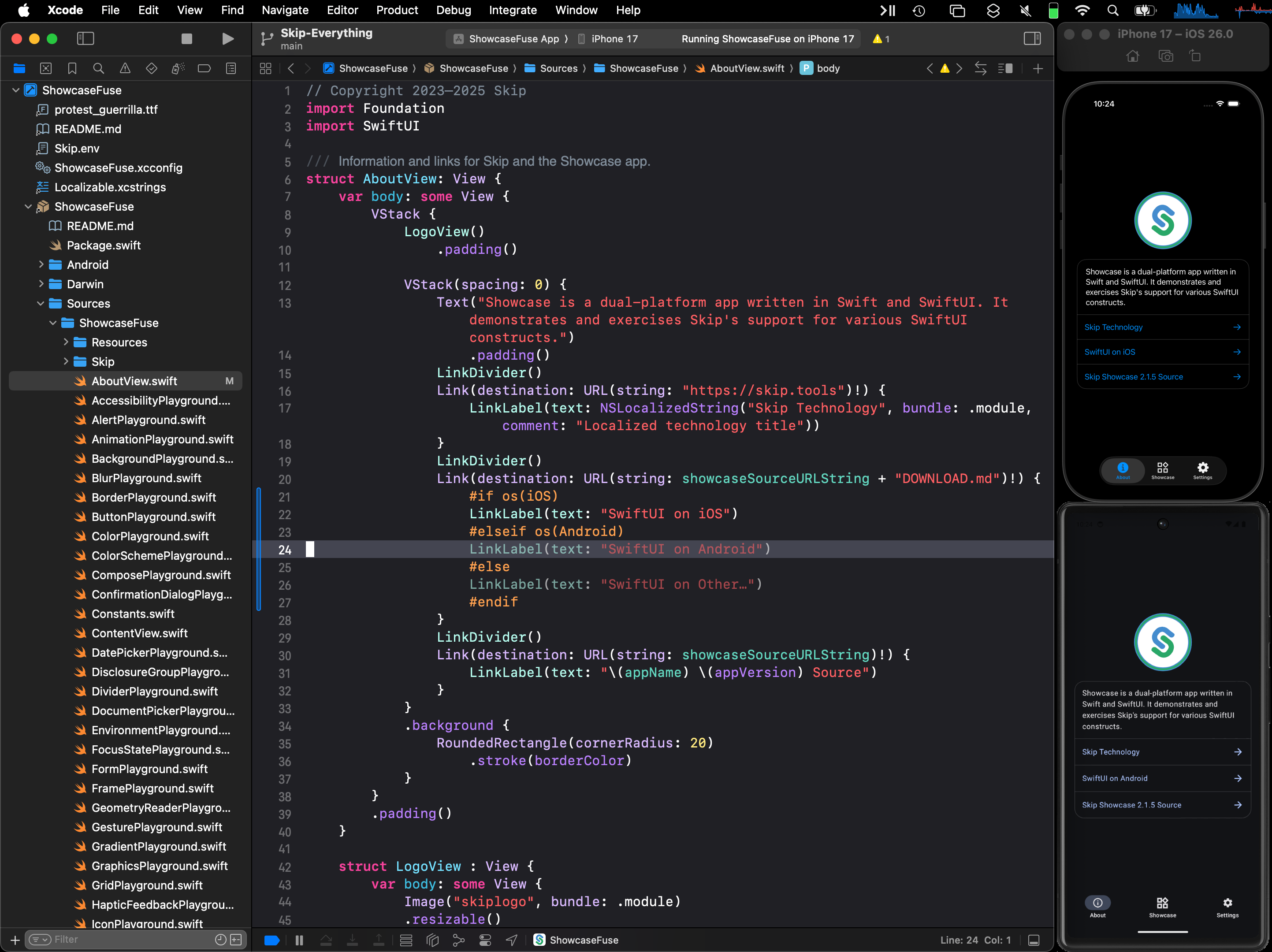
Note that this SDK is not just theoretical, but is in active use today in many Skip-powered applications. Our own Skip Showcase5 app has been running using this SDK, and provides a comprehensive sample of what is possible when you combine native Swift with Skip’s SwiftUI implementation for Android.

Since we announced the availability of the Swift SDK for Android, there has been an explosion of interest in the project. Many heretofore skeptics are realizing that this is real, and are seeing that Swift is a viable choice as the one language for their entire application stack — on all platforms. No longer do developers need to make the agonizing choice between writing an application in two separate native languages, versus settling on an inefficient and alien language like JavaScript or Dart for their shared codebase.

For Skip itself, this development grants us an enormous amount of confidence-building support. Swift on Android is here to stay. And so even if Skip as a product were to somehow disappear tomorrow, any investment that is made in Swift for Android development would continue be a viable and supported path going forward. Swift on Android is available today, it has official backing by the Swift project, and it is here to stay. The future is bright!

Screenshot of Skip Showcase native app
Download on the Google Play Store Download on the Apple App Store
  1. Swift on Android Working Group, Community Showcase, February 10, 2025: https://forums.swift.org/t/swift-on-android-working-group/77780

  2. Announcing the Android Workgroup, June 25, 2025: https://forums.swift.org/t/announcing-the-android-workgroup/80666

  3. Native Swift on Android, Part 1: Setup, Compiling, Running, and Testing: /blog/native-swift-on-android-1/

  4. Announcing the Swift SDK for Android: https://www.swift.org/blog/nightly-swift-sdk-for-android/

  5. Skip Showcase /docs/samples/skipapp-showcase-fuse/

Skip Showcase: Securing your secrets with SkipKeychain

Skip is a technology that enables the creation of dual-platform iOS/Android apps from a single shared Swift and SwiftUI codebase. The headline feature of Skip is that it takes your SwiftUI interface and automatically translates it into the equivalent Jetpack Compose interface, so your app is genuinely native on both platforms.

However, there is much more to Skip than just SwiftUI: there is a whole suite of optional modules that you can add to your project that provide additional integrations with the underlying platform. These are primarily distributed as free and open-source Swift Package Manager repositories under the skiptools GitHub organization, but many developers have also created their own. The equivalent package index in the Flutter world would be pub.dev, and the closest thing for React might be expo.dev.

This first post in the “Exploring Showcase” series will discuss the SkipKeychain module, which provides a common API for accessing encrypted secrets on both iOS and Android. Future entries will cover other integrations, such as native embedded web views and video players, Lottie animations, Firebase support, local SQLite persistence, Bluetooth and NFC hardware, and device sensor access.

As with many of Skip’s features, we provide a demonstration in our eponymous “Showcase” app, which is available on both the Apple App Store and Google Play Store, and whose full source code is available in the skipapp-showcase repository.

Download on the Google Play Store Download on the Apple App Store

The SkipKeychain module provides the ability to store and retrieve “secrets” on the device. These are small pieces of data, such as passwords, notes, and encryption keys, that need to be secured locally.

Apple offers a set of Keychain services1 APIs that provide access to their Keychain on iOS (as well as macOS and others). On Android, the EncryptedSharedPreferences is a Jetpack security library feature that encrypts key-value pairs before storing them in a SharedPreferences file.

SkipKeychain is a great example of the power of Skip’s integration capabilities, because it is so simple. The whole thing is implemented in a single ~300 line file, SkipKeychain.swift. This is a transpiled module, but it is bridged to native Swift, so it can be used equally well from a Skip Lite or Skip Fuse app2.

The API surface is quite simple:

import SkipKeychain
let keychain = Keychain.shared
try keychain.set("value", forKey: "key")
assert(keychain.string(forKey: "key") == "value")
try keychain.removeValue(forKey: "key")
assert(keychain.string(forKey: "key") == nil)

The Showcase playground for the Keychain uses this API like so:

import SwiftUI
import SkipKeychain
struct KeychainPlayground: View {
@State var allKeys: [String] = []
/// load all the keys from the keychain
func loadKeys() {
allKeys = ((try? Keychain.shared.keys()) ?? []).sorted()
}
var body: some View {
List {
Section {
ForEach(allKeys, id: \.self) { key in
NavigationLink {
KeychainValueEditor(key: key, isNewKey: false)
} label: {
Text(key)
}
}
.onDelete { indices in
for keyIndex in indices {
try? Keychain.shared.removeValue(forKey: allKeys[keyIndex])
}
loadKeys()
}
}
}
.onAppear {
loadKeys()
}
}
}

The result is a very simple yet functional secret manager which behaves identically on both iOS and Android:

One takeaway from this very simple and useful framework is just how simple it is to develop and iterate on, unlike the cumbersome bridging technologies needed by other cross-platform frameworks, which often force the developer to implement platform support across multiple separate projects with a variety of languages and build tools.

In contrast, Skip’s framework support is as simple as can be: a single standard Swift Package Manage project using the skipstone plugin. Kotlin and Java APIs for Android can be dropped right into #if SKIP blocks, and the whole thing can be tested using SwiftPM’s built-in testing support. And using the framework is just as standard: it is a simple Swift Package Manager dependency, added like:

let package = Package(
name: "skipapp-showcase",
products: [
.library(name: "Showcase", type: .dynamic, targets: ["Showcase"]),
],
dependencies: [
.package(url: "https://source.skip.tools/skip.git", from: "1.0.0"),
.package(url: "https://source.skip.tools/skip-ui.git", from: "1.0.0"),
.package(url: "https://source.skip.tools/skip-keychain.git", "0.3.0"..<"2.0.0"),
],
targets: [
.target(name: "Showcase", dependencies: [
.product(name: "SkipUI", package: "skip-ui"),
.product(name: "SkipKeychain", package: "skip-keychain"),
], plugins: [.plugin(name: "skipstone", package: "skip")]),
]
)

The Skip philosophy is to take modern iOS-first development practices, and build on top of them to provide the ability to reach the entire marketplace. It does not add a whole new language and runtime on top of the platform, but instead enables unintermediated access to the platform using the native development language for each: Swift on iOS and Kotlin on Android. This results in the smallest app size possible, the most efficient performance, and the absolute best user experience possible, while still enabling the development of your app from a single codebase.

As always, Happy Skipping!

  1. Keychain services: “Securely store small chunks of data on behalf of the user.” — https://developer.apple.com/documentation/security/keychain-services

  2. For more on the distinction between transpiled Skip Lite and compiled Skip Fuse apps, see Skip Fuse vs. Lite.

Skip on the Swift Package Indexing Podcast

I was thrilled to be interviewed by Dave and Sven from the Swift Package Indexing podcast the other day! We talked about a wide range of topics around the founding of the Swift Android Workgroup, the progress that Swift is making in expanding into other platforms, and how Skip builds on the Swift Android SDK to enable building both iOS and Android apps from the same SwiftUI codebase.

We also discussed some tips for Swift package developers to make their own packages compatible with Android, and talked about the recent addition of Android compatibility to the supported platforms matrix for packages on https://swiftpackageindex.com.

You can check out Episode 61: “People have been working on it for ten years” for the full transcript and show notes.

Peter and Sven are gracious hosts, and I greatly enjoyed our conversation.