Ir al contenido
Skip

announcement

4 posts with the tag “announcement”

Skip Is Now Free and Open Source

Since launching Skip in 2023, we’ve pursued one mission: enable developers to create premium mobile apps for iOS and Android from a single Swift and SwiftUI codebase — without any of the compromises that have encumbered cross-platform development tools since, well, forever.

Over the past three years, Skip has evolved significantly. We started with a Swift-to-Kotlin transpiler and Android support for the most common SwiftUI APIs. We then founded the Swift Android Workgroup and released the Swift Android SDK to compile Swift natively for Android. We now have dozens of popular integration frameworks, interoperate with thousands of cross-platform Swift packages, and feature the most complete independent SwiftUI implementation available.

Until today, Skip has required a paid subscription and license key to build apps. While free apps and indie developers below a revenue threshold were exempt, businesses were expected to subscribe. This model helped us bootstrap Skip without outside investment, but we’ve always known that to truly compete with legacy cross-platform tools and achieve widespread adoption, Skip would need to become freely available.

The plain truth is that developers expect to get their tools free of charge. First-party IDEs like Xcode and Android Studio, popular integration frameworks, and essential dev tools are all given away at no (direct) cost. The platform vendors monetize through developer program fees, app store commissions, and cloud services. Framework providers typically monetize through complementary services. But developer tools? Those have historically required the patronage of massive tech companies in order to fund their ongoing development, support, and infrastructure costs.

Beyond pricing, there’s a deeper concern about durability. Developers are understandably wary of building their entire app strategy on a small company’s paid, closed-source tool. What if the company goes under? Gets acquired and shut down? What happens to their apps? We get it. While Skip’s innate ejectability offers some risk mitigation, product teams need absolute confidence that their chosen technologies will be around next week, next year, and beyond. They must remain immune from the dreaded “rug pull” that so often accompanies a “pivot”.

To keep the development community’s trust and achieve mass adoption, Skip needs a completely free and open foundation. Even if the core team disappeared, the community could continue supporting the technology and the apps that depend on it.

As of Skip 1.7, all licensing requirements have been removed. No license keys, no end-user license agreements, no trial or evaluation period.

  • Current Skip developers: Your setup remains completely unchanged, except you will no longer need your license key after upgrading.
  • New Skip users: You can start building immediately — no evaluation license required.
  • Open source skipstone: We’ve open-sourced the Skip engine, known as “skipstone”. This is the tool that handles all the critical build-time functionality: Project creation and management, Xcode and SwiftPM plugin logic, iOS-to-Android project transformation, resource and localization bundling, JNI bridge creation, source transpilation, app packaging, and project export. It is now available as a public GitHub repository at https://github.com/skiptools under a free and open-source license.
  • Migrate skip.tools to skip.dev: As part of this process, we are launching our new home at https://skip.dev! This new site hosts our documentation, blog, and case studies, and it is also open-source and welcomes contributions at https://github.com/skiptools/skip.dev. We will eventually be migrating the entirety of https://skip.tools to https://skip.dev.

Since day one, Skip has been bootstrapped. We haven’t taken venture capital or private equity investment, nor are we controlled by big tech. This independence means we control our destiny and can make the best decisions for Skip’s developers and users — a unique position in the cross-platform development space.

But independence requires community support. And that is where you come in.

  • Current subscribers: Your Small Business or Professional plan will automatically transition to an Individual or Supporter tier, respectively. You can cancel any time with no consequences (other than making us sad), but we hope you’ll consider staying on, at least throughout this transition period.
  • Individual developers: If you believe in Skip’s mission, please consider supporting us through GitHub Sponsors with a monthly contribution.
  • Companies and organizations: For businesses that want to see Skip flourish, we offer corporate sponsorship tiers with visibility on our homepage and in our documentation. Your sponsorship directly funds development of the integration frameworks essential to production apps, as well as the ongoing maintenance, support, and infrastructure. Sponsorship comes with some compelling perks! Please visit https://skip.dev/sponsor to see the sponsorship tiers.

Investing in Skip is also investing in your own team’s capabilities and competitive advantage. Your support accelerates Skip’s development and ensures its long-term success, enabling your developers to build exceptional native experiences efficiently, today and into the future.

We’re at a pivotal moment in the app development field. Legacy cross‑platform frameworks are struggling to keep pace with the rapid evolution of modern UI systems like Liquid Glass on iOS and Material Expressive on Android. The compromises that once felt acceptable in exchange for a unified codebase now result in dated interfaces, weaker user experiences, and real competitive disadvantages. Teams ready to move beyond those trade‑offs can count on Skip to champion what matters most: delivering truly native, uncompromised experiences on both major mobile platforms.

Opening Skip to the community marks the next step in its evolution. Software is never finished — especially a tool that supports modern Swift and Kotlin, SwiftPM and Gradle, Xcode and Android Studio, iOS and Android, and the ongoing growth of SwiftUI and Jetpack Compose. It’s a demanding pursuit, and we’re committed to it. But sustaining and expanding this work depends on the support of developers who believe in Skip’s mission.

Together, we will continue building toward Skip’s vision: a genuinely no‑compromise, cross‑platform foundation for universal mobile apps.

Thank you for your support, and as always, Happy Skipping!


Ready to get started? Get started with Skip 1.7 today and join the community building the future of native cross-platform development.

An official Swift SDK for Android

When we first launched Skip in 2023, the notion of using Swift to create universal mobile applications was novel. While some projects had dabbled with custom Swift toolchains to share some of their business logic between iOS and Android, no one had ever undertaken the effort to enable building the entire application stack — from the low-level networking and persistence all the way up to the user interface — using just the Swift language.

But the time was right. SwiftUI was just reaching maturity, and its declarative design was flexible enough to target not only the mobile phone form factor, but also to scale all the way up to the full desktop and all the way down to the smartwatch. Expanding SwiftUI’s architecture to the “other” mobile platform was a daunting engineering challenge, but it made perfect sense from the standpoint of facilitating the creation of a whole app using a single language.

Developers who have adopted Skip for their dual-platform app development have loved it. But there has always been an undercurrent of caution and reservation about the future of the project, especially from larger enterprises for whom the architecture decisions were central to their business’ future. As we’ve written in the past, the best-in-class apps that top the charts on both the App Store and Play Store are not written once, but twice: they are written first in Swift for iOS, and then they are re-written in Kotlin for Android. Despite being enormously laborious to coordinate and maintain, writing the app twice has always been considered the safe choice, not just because it enables optimal performance and a truly native user interface, but also because they are using the languages and APIs that are recommended and supported by the operating system vendors themselves. How could an independent project by a small team possibly offer the same guarantees of technological durability?

Such concerns have presented a challenge and barrier against the adoption of Skip for cross-platform app development since the beginning. And so we joined together with some other visionaries and founded the Swift on Android Community Working Group1 earlier this year. Our goal was to collaborate in harnessing and coordinating the energies of various developers and businesses that had each dabbled in using Swift in some way for their Android apps.

The workgroup had so much excitement behind it that a few months later, it was blessed by the Swift Platform Steering Group as an official workgroup2, which meant that we had the backing and support of the Swift community as a whole. This was huge: Swift on Android was no longer a niche interest for risk-taking startups and indie developers, but was going to evolve into a fully-supported platform for the Swift language.

Work began in earnest. Since last year, Skip has been using an unofficial preview build of the toolchain and native Swift SDK for Android to power our “Skip Fuse” mode3. Using this technology as a base — which had evolved over the years in a somewhat haphazard fashion — we began the long process of getting it in shape for official approval and release: cleanup, bug fixes, ripping out unsupported dependencies, harmonizing the structure with other Swift SDKs, packaging, quality control, and continuous integration.

The culmination of all these efforts has at last arrived! As announced on the swift.org blog4, we are now publishing the Swift SDK as an officially supported platform. The Swift SDK for Android is available alongside the Static Linux (Musl) and WebAssembly (Wasm) SDKs, and will be available in nightly snapshot releases throughout the Swift 6.3 release cycle.

As mentioned, Skip is currently using our own preview release build of this SDK for our native Skip Fuse mode. So switching over to this official SDK will be smooth and painless for our current customers. We anticipate that the final Swift 6.3 release will be the point where we include it by default in the Skip installation and setup instructions.

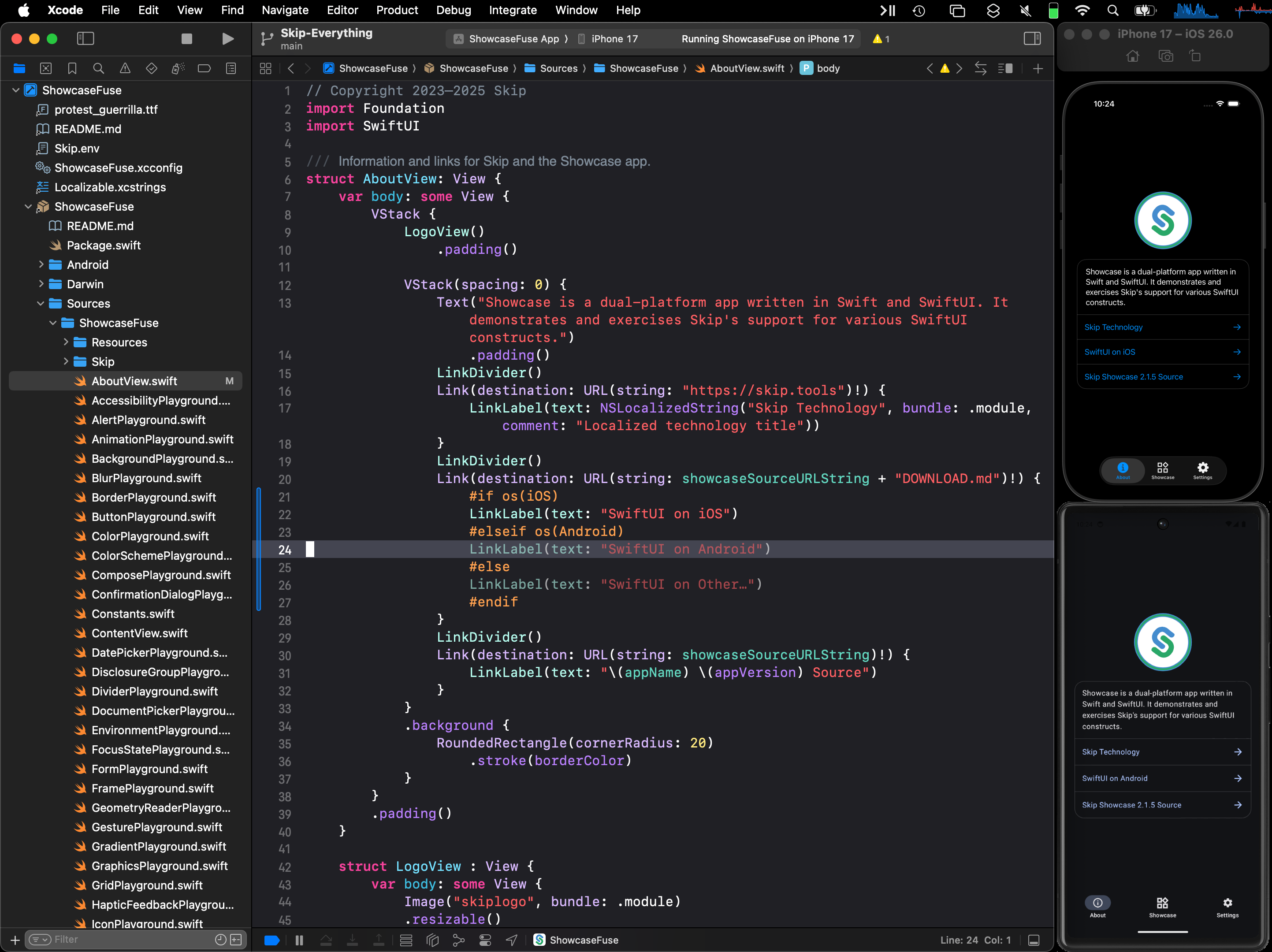
Note that this SDK is not just theoretical, but is in active use today in many Skip-powered applications. Our own Skip Showcase5 app has been running using this SDK, and provides a comprehensive sample of what is possible when you combine native Swift with Skip’s SwiftUI implementation for Android.

Since we announced the availability of the Swift SDK for Android, there has been an explosion of interest in the project. Many heretofore skeptics are realizing that this is real, and are seeing that Swift is a viable choice as the one language for their entire application stack — on all platforms. No longer do developers need to make the agonizing choice between writing an application in two separate native languages, versus settling on an inefficient and alien language like JavaScript or Dart for their shared codebase.

For Skip itself, this development grants us an enormous amount of confidence-building support. Swift on Android is here to stay. And so even if Skip as a product were to somehow disappear tomorrow, any investment that is made in Swift for Android development would continue be a viable and supported path going forward. Swift on Android is available today, it has official backing by the Swift project, and it is here to stay. The future is bright!

Screenshot of Skip Showcase native app
Download on the Google Play Store Download on the Apple App Store
  1. Swift on Android Working Group, Community Showcase, February 10, 2025: https://forums.swift.org/t/swift-on-android-working-group/77780

  2. Announcing the Android Workgroup, June 25, 2025: https://forums.swift.org/t/announcing-the-android-workgroup/80666

  3. Native Swift on Android, Part 1: Setup, Compiling, Running, and Testing: /blog/native-swift-on-android-1/

  4. Announcing the Swift SDK for Android: https://www.swift.org/blog/nightly-swift-sdk-for-android/

  5. Skip Showcase /docs/samples/skipapp-showcase-fuse/

Skip is Free for Free Software

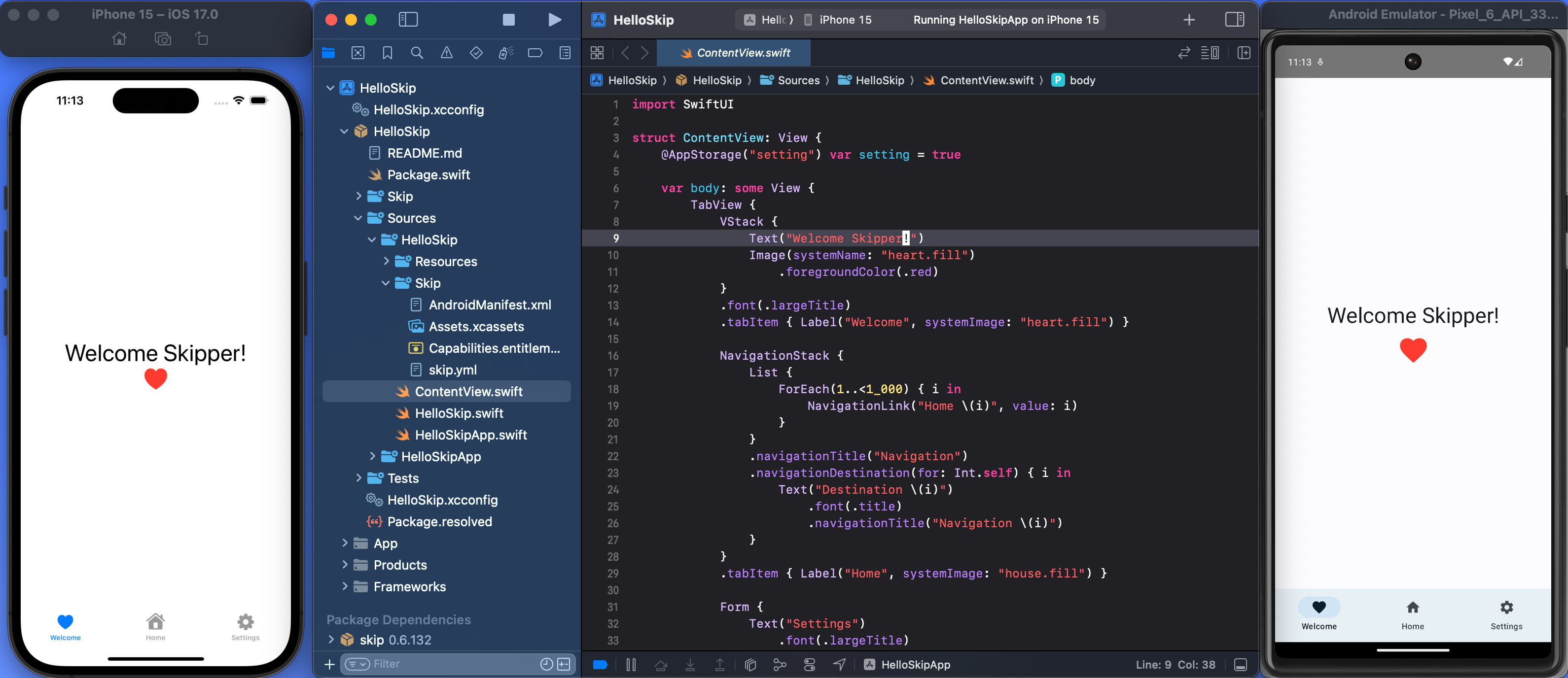
Skip brings your iPhone app to Android. With Skip, you can create a modern SwiftUI app with the standard iOS development tools, and Skip transforms it into a Kotlin app for Android. With Skip you can iteratively design, build, test, run, debug, and deploy a single app for both major mobile platforms using a single language (Swift) and a single IDE (Xcode). Watch our 12-minute tour for a glimpse of the magic.

Today we are pleased to announce that Skip will be free for all free open-source software.

There are two halves to the Skip project. The first is SkipStone, our integrated Xcode plugin that transpiles your Swift source code into Kotlin as part of the normal build process. SkipStone is commercial software. It is currently a public technology preview, with early adopter pricing to be announced soon1.

The other half is Skip’s ecosystem of libraries and frameworks, which is free and open-source software. These frameworks constitute the essential building blocks of any modern application, and include low-level adaptors from Darwin’s Foundation API to the equivalent Android Java API (skip-foundation), as well as the high-level SwiftUI user interface widgets that are manifested by Jetpack Compose views on Android (skip-ui). In addition, the growing constellation of community frameworks at github.com/skiptools provides essential functionality such as SQL database support, media player components, and more.

These frameworks are free and open-source software whose advancement will rely heavily on community contributions. And so we’ve made the SkipStone transpiler free, for free software. What this means is that Skip can be used – without cost – for building projects that consist exclusively of source code licensed under one of the General Public Licenses as published by the Free Software Foundation.

This applies not just to framework development, but also to your own app projects: if your iOS app is free software, then Skip can be used to transpile it into an equivalent free Android app. In this way we hope to encourage and support the proliferation of genuinely native dual-platform apps created with the Skip transpiler and powered by the community-supported ecosystem of high-quality libraries and frameworks.

Skip is advancing by leaps and bounds, but it is still a technology preview. You can use it today to create a greenfield app for iOS and Android, provided you are willing to iterate carefully and to work around (or implement and contribute!) some missing pieces. Read the getting started guide to begin the adventure.

The reward will be well worth the effort. Your genuinely native app, created from a single modern Swift codebase, running on both Android and iOS, will be priceless.

More details can be found at our FAQ and documentation. Follow us on Mastodon at mas.to/@skiptools or with RSS.

  1. Commercial pricing will be announced soon, but you can qualify for an early adopter discount by registering during the tech preview period.

Announcing the Skip Technology Preview!

We’re thrilled to announce the tech preview of Skip: dual-platform app development in Swift.

Screenshot

You write a modern iPhone app, and Skip transpiles it into a native Android app in real time.

Skip is the only solution that enables the creation of genuinely native apps for both iOS and Android with one language, one team, and one codebase.

Check out the video tour and visit the FAQ and documentation to get started. Sign up at skip.dev to be notified about future updates.

Happy Skipping!